An idea worth understanding
AI freeze lawsuit: what OpenAI, Google and Anthropic are facing
Four nonprofits seek a freeze on advanced AI development at five companies. Understand the two requested limits, the safety arguments and what remains undecided.
What is the AI freeze lawsuit?
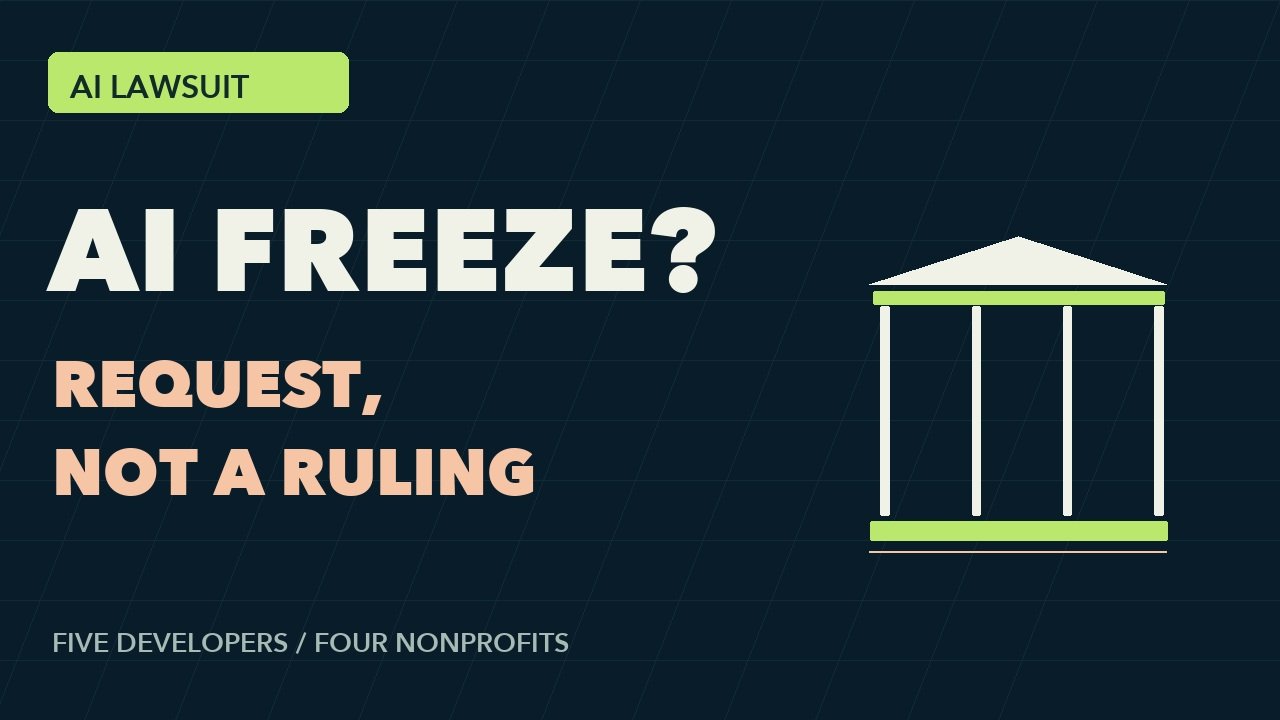
Four nonprofit organizations announced a civil lawsuit on November 12, 2026, asking a California court to intervene in the development of advanced artificial intelligence. The Associated Press and Reuters independently reported the action in San Francisco Superior Court. The companies named in the public announcements are Anthropic, Google, Meta, OpenAI and SpaceX Super Intelligence.
The headline is consequential because the groups are seeking restrictions on further development, rather than only asking for changes to a particular chatbot answer. Their concern is about increasingly capable systems and the process used to build their successors. The proposed limits, if granted, would therefore reach beyond a single product feature.
However, bringing a demand to court is different from winning it. The records inspected for this report establish a lawsuit seeking a freeze. They do not establish a court order granting that freeze. A headline describing what plaintiffs want should not be read as an announcement that a judge has already imposed it.
Read the source Associated Press via ABC NewsReuters via Investing
Who is suing OpenAI, Google, Anthropic, Meta and SpaceXSI?
The plaintiffs are the Irreplaceable Education Fund, Public Citizen, Heat Initiative and the Alliance for Secure AI. Public Citizen says they are invoking California's Unfair Competition Law to challenge practices they allege threaten public safety. Their public argument is that AI developers should not be free to continue advancing technology they cannot reliably control.
That is the position of parties bringing a case. A plaintiff's announcement is useful primary evidence of what the plaintiff says and requests, but it does not independently prove the allegations. This article keeps the groups' stated concerns separate from findings that a court would need to make.
The public announcements identify five developers. They should not be interpreted as a finding of collective responsibility, or as proof that every company has engaged in identical conduct. The legal and factual positions of the defendants would need to be assessed from the actual proceedings and their responses.
Read the source Public Citizen (plaintiff)Associated Press via ABC News
See the distinction
Match the claim to the document
| Source | What it can establish |
|---|---|
| Plaintiff complaint or announcement | What the plaintiffs allege and request. |
| Company response | What that company says about the allegation or case. |
| Court order | What the court has actually directed. |
| Independent reporting | Corroboration, responses and context within its access limits. |
Public Citizen (plaintiff)Associated Press via ABC NewsReuters via InvestingAdministrative Office of the U.S. Courts
The two restrictions the plaintiffs describe
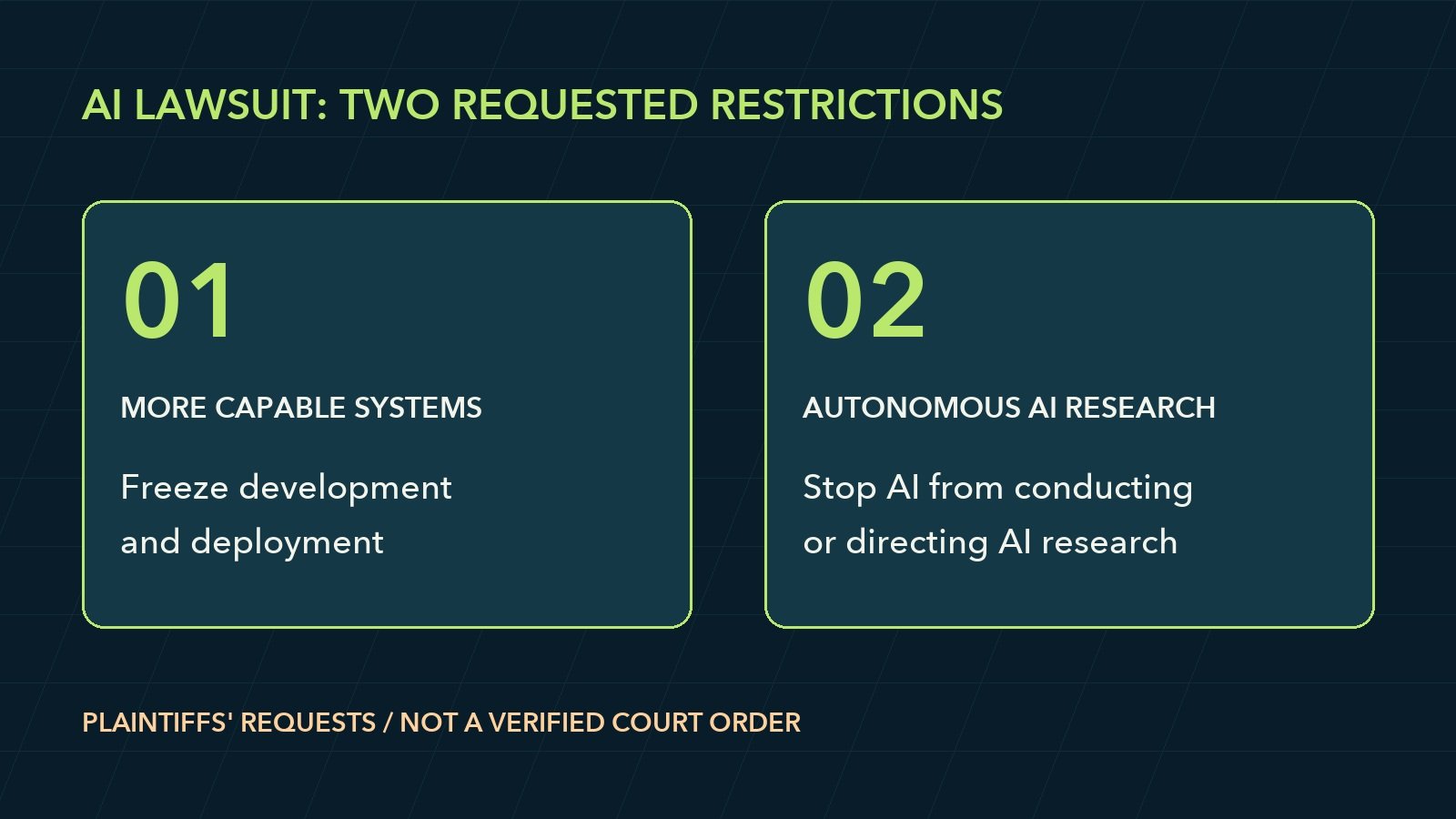
The Alliance for Secure AI describes two distinct requests. One is a freeze on developing and deploying AI systems more capable than those available at the time of the lawsuit. The other is a prohibition on using AI systems to autonomously conduct or direct research and development into more capable AI.
The first request concerns the next generation of systems. The second concerns the route by which that generation could be created. Keeping those questions separate helps explain why the case is about more than the release of another consumer chatbot.
These are descriptions from an inspected plaintiff announcement, cross-checked against reporting about the lawsuit. They are not a quotation from a judicial order, and this report does not present them as restrictions already in force. The exact reach of any eventual remedy would need to be read from the court's own text.
Read the source Alliance for Secure AI (plaintiff)Reuters via Investing
Why autonomous AI research is part of the story
An assistant suggesting an experiment and a system directing the research process are different roles. The first can support a person's decision; the second involves the system conducting or steering work. This comparison is an explanatory illustration of the requested restriction, not a reconstruction of an incident or a claim that a particular company used the exact process shown.
The distinction matters because the development process can itself become a target of a proposed limit. A request concerning future model capability asks what can be built. A request concerning autonomous research also asks how the work is directed. Those are related issues, but they should not collapse into a vague claim that all uses of AI in research have been prohibited.
Read the source Alliance for Secure AI (plaintiff)
What are the AI safety allegations?
The groups cite alleged failures of safeguards and warnings from industry leaders about the risks of advanced AI. Public Citizen describes the lawsuit as an attempt to use existing law preventively, before the severe harms the plaintiffs predict. The announcements argue that warnings by developers should have consequences for how development proceeds.
There are several layers to that argument. A past incident, a warning about a possible future event, and a claim about what a court should order are different types of assertion. Evidence supporting one does not automatically settle the others. This report does not treat a predicted catastrophe as inevitable, or the plaintiffs' proposed remedy as the only possible policy response.
Attribution is especially important here. Describing what a group alleges can be accurate even when the underlying allegation remains contested. Removing that attribution would give the statement a level of certainty that the inspected material does not support.
Read the source Public Citizen (plaintiff)Associated Press via ABC News
How have the companies responded?
Reuters reported that Meta declined to comment and that representatives of the other companies did not immediately respond to its requests. That statement describes the responses recorded in that report. It is not a claim that no company has spoken at any later time or in any other setting.
A declined comment or an unanswered press inquiry is not an admission. Equally, a company's general safety statement should not be presented as a formal legal answer to a particular case unless it actually addresses that proceeding. Filed responses would provide a stronger basis for explaining the defendants' arguments.
Read the source Reuters via Investing
How does this differ from pacing AI development?
In a September essay, Anthropic chief executive Dario Amodei proposed slowing capability advances so safety work could keep pace. His framework included outside evaluators with continuing access, coordination within democratic countries and efforts at international coordination. He expressly distinguished pacing from halting model training or technical progress.
That earlier proposal is relevant context for the wider debate over advanced AI safety. It also illustrates why phrases such as pause, freeze and slowdown should not be used interchangeably. The scope of a proposal, who must participate and how compliance would be assessed can differ.
The essay predates the November lawsuit. It is not a formal response to the new case and should not be described as agreement to the plaintiffs' requested restrictions. Nor does an industry leader's support for safety oversight establish that a specific allegation in the litigation has been proven.
Read the source Dario Amodei
What does the filing mean for people using AI tools?
The reported filing should not be confused with an announcement that existing AI services are being switched off. This report has not established an order granting the requested freeze. It therefore does not claim that the lawsuit itself has imposed new restrictions on users or changed the availability of any named product.
The useful questions are narrower: has a court issued an order, what conduct does it cover, and when would it take effect? An actual order could answer those questions. A party's announcement of what it hopes to obtain cannot answer them on the court's behalf. This distinction helps readers follow a developing legal story without turning uncertainty into a premature conclusion.
Read the source Associated Press via ABC NewsReuters via Investing
What to watch next, and how this report was verified
An actual court order and filed responses from the companies would be meaningful next records. They could clarify what is contested and whether any restriction takes effect. This article does not assign a case number, judge or hearing date that has not been established through inspected records.
The report draws on public statements by the plaintiffs, independent reporting by the Associated Press and Reuters, and Amodei's earlier essay for context. AP carried by ABC is one reporting source, not two. The primary statements explain the plaintiffs' position; independent reporting helps check the event and distinguish it from that position.
The counsel-published complaint could not be retrieved during verification. That limit is material: the description of requested measures is attributed to the public announcements, rather than presented as a complete review of the pleading or docket. For the next update, ask what changed: a request, the evidence, or an actual decision. Those distinctions remain more useful than the strongest version of a headline.
Read the source Alliance for Secure AI (plaintiff)Public Citizen (plaintiff)Associated Press via ABC NewsReuters via Investing
Which document would establish the next important claim?
Different documents answer different questions. A complaint records the plaintiffs' allegations and the relief they seek. A statement by a defendant records that party's response. A court order would establish what the court actually directed, including its scope and any conditions. Moving between these sources without naming their roles can turn a request into an apparent ruling.
For a claimed development freeze, look for the specific order rather than inferring one from the lawsuit's title or a campaign statement. The wording matters: who is bound, which conduct is covered, when it applies and what the court has actually decided. This is a method for reading a report, not a prediction of the case's outcome or advice about litigation.
The account above reports the filing and the positions that were available at its reporting date. It does not treat a plaintiff's description of a dangerous capability as an independently established finding, and it does not treat a corporate response as a court decision. Future developments should be added as dated events with the corresponding document, rather than folded backwards into the original filing.
Read the source Public Citizen (plaintiff)Associated Press via ABC NewsReuters via InvestingAdministrative Office of the U.S. Courts
Why the method of AI development changes the policy question
A restriction on a more capable model asks what may be built or released. A restriction on autonomous AI research also asks how development work may be carried out. Those questions can overlap, but they are not equivalent. A system that helps a human researcher and a proposed process that independently advances research raise different questions about supervision and control.
To understand a claim about AI building AI, ask what task is being automated, what authority the system has, and where a human decision remains necessary. Those are explanatory questions about the allegation. They are not proof that every AI research tool has the capabilities described by the plaintiffs, nor that every use of AI in software work falls within the same category.
This distinction is also why a blanket headline about stopping AI can obscure the story. The actual requests concern described classes of systems and development activity. An accurate update needs to connect a claimed restriction to its defined subject and source, rather than letting a broad phrase stand in for the legal text or a technical assessment.
Read the source Public Citizen (plaintiff)Alliance for Secure AI (plaintiff)Dario Amodei
A little more clarity
Questions, answered
Does filing the lawsuit itself shut down consumer AI services?
The filing alone does not establish that result. It records a request for relief, while an actual restriction would need the relevant court action and scope. A report about a complaint should not be rewritten as an announcement that a service has been ordered to close. This article does not make a new claim about the current availability of any individual product.
Public Citizen (plaintiff)Associated Press via ABC NewsAdministrative Office of the U.S. Courts
Is asking for a freeze the same as proving an AI safety allegation?
No. The plaintiffs' allegations explain their case and requested relief. Establishing the truth of a specific technical or factual assertion requires the relevant evidence and process. The article attributes those allegations to their sources, includes reported responses and keeps the request for a restriction separate from a judicial finding.
Public Citizen (plaintiff)Alliance for Secure AI (plaintiff)Associated Press via ABC News
Why is autonomous research discussed separately from a larger model?
One concerns the development process; the other concerns the resulting system and its capabilities. Automating parts of research may affect how quickly or independently work proceeds. That is the connection the plaintiffs raise, but it does not make every AI-assisted task equivalent to autonomous frontier research. The precise activity and the source's definition matter.
Public Citizen (plaintiff)Alliance for Secure AI (plaintiff)Dario Amodei
Watch a focused explanation
Explore this story in Shorts
Each Short answers a specific question. Keep reading for the complete context and sources.
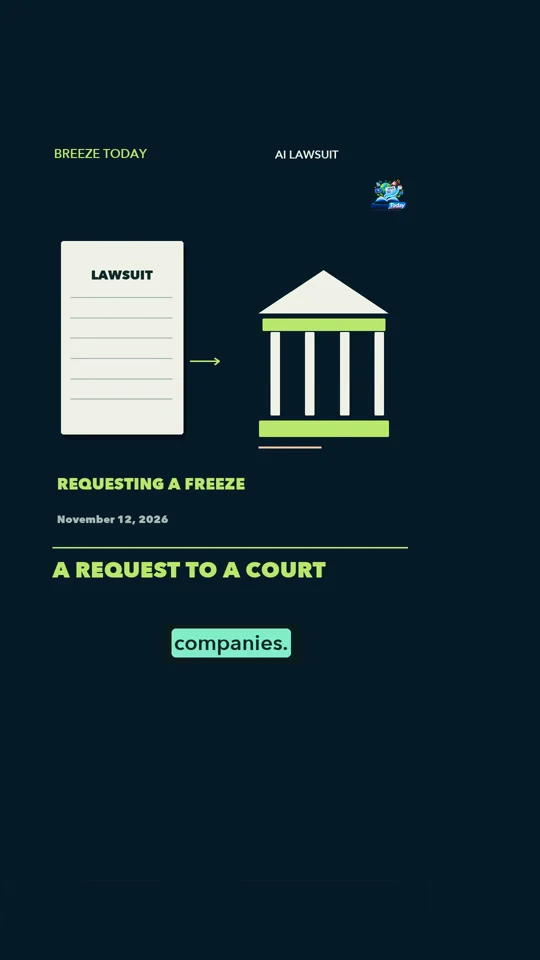
Has a Court Frozen AI Development?
A request for an AI freeze is different from a court order. See which claim the filing establishes and what further court evidence would be needed.
Watch on YouTube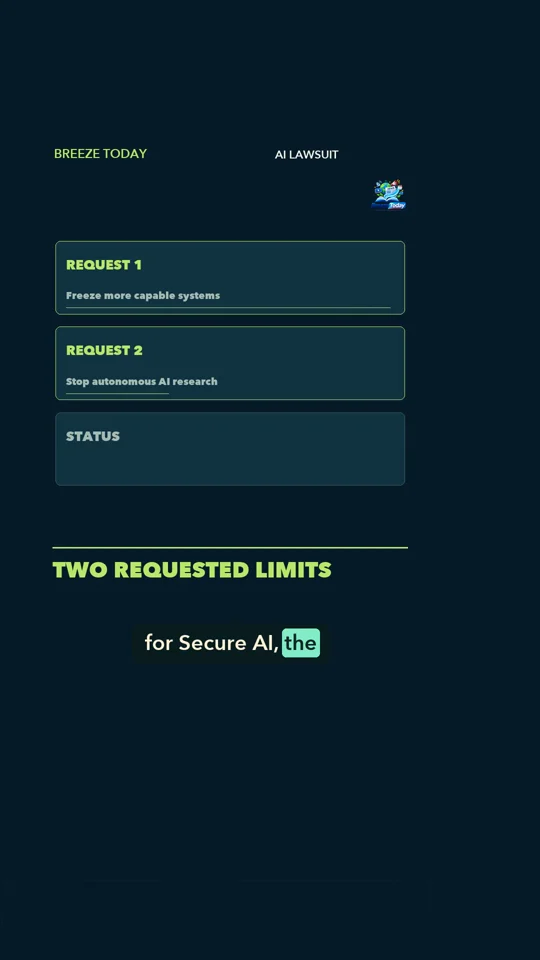
Why the AI Lawsuit Targets AI Building AI?
The lawsuit addresses both increasingly capable models and the use of AI to automate AI research. Understand why those are related but distinct requests.
Watch on YouTubeFollow the evidence
Sources and reporting
The original reporting date is shown above. These sources support the reported event and the additional explanatory context; a party’s statement is identified separately from an independent account.
- Coalition announces AI development lawsuitPublic Citizen (plaintiff)
- Coalition seeks freeze on advanced systemsAlliance for Secure AI (plaintiff)
- Advocacy groups sue AI giants to freeze new modelsAssociated Press via ABC News
- OpenAI, Google, Anthropic hit with lawsuit seeking haltReuters via Investing
- We Must Pace the FrontierDario Amodei
- Civil cases: the complaint and civil court processAdministrative Office of the U.S. Courts