The cash receipt explained
Common Cents Act: How Cash Rounding Works After the New Penny Law
The Common Cents Act is law. See when cash totals round up or down, why pennies remain legal tender, and why card payments stay exact.
What did the Common Cents Act change?
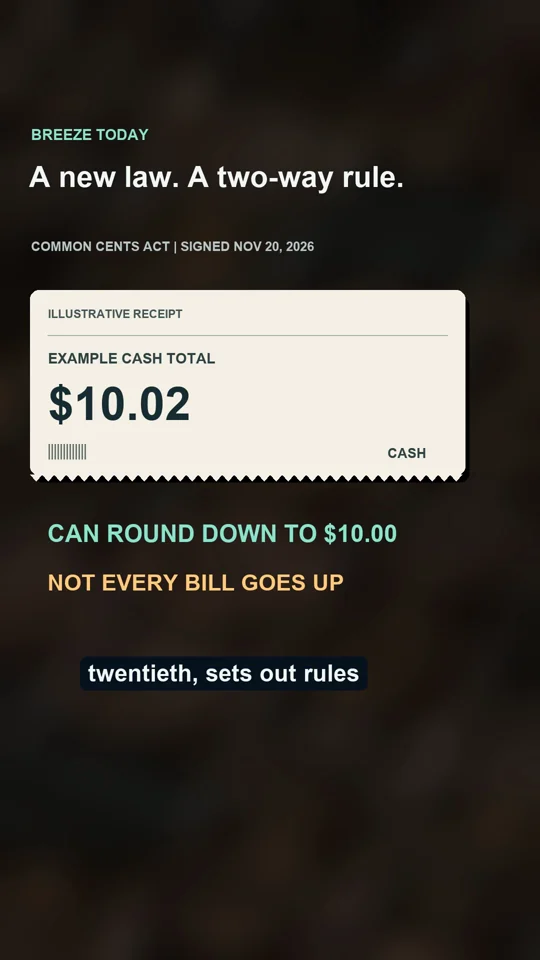
The Common Cents Act became law on November 20, 2026. The White House confirmed the signing of H.R. 10167, and the enrolled legislation sets out the operative rules. It ends production of one-cent coins for general circulation, permits continued collector issues and creates a federal framework for specified cash rounding. The practical checkout question is not simply whether the penny disappears: it is which amount can be rounded, in what direction and under which circumstances.
The answer is more nuanced than a headline saying every cash purchase will increase. Section 3 uses permissive language, and its rule of construction explicitly says the Act does not require a person to round the payments described in subsections (a) or (b). Its ordinary nearest-five-cent mechanism allows eligible amounts to move down or up. Different provisions address customer-favorable rounding and cash wages. Those distinctions matter when comparing a receipt with a general summary of the law.
Read the source White HouseUS Government Publishing OfficeMark Schoeff Jr / CQ Roll Call
Did penny production stop in 2026 or 2025?
The production shutdown predates the new statute. The U.S. Mint held its ceremonial final strike for the circulating one-cent coin on November 12, 2025, at its Philadelphia facility. The November 2026 law supplies a statutory end to production for general circulation and the accompanying framework. Showing that earlier ceremony as if it happened at the new signing would confuse two separate events a year apart.
The law also preserves the status of previously minted and issued pennies as legal tender for debts, public charges, taxes and dues. It does not turn the coins in a jar or cash drawer into worthless objects. Nor does ending circulation production mean every collector penny is prohibited: numismatic production may continue. Legal-tender status should not be confused with a promise about the payment methods every business will accept in every circumstance.
Read the source US MintUS Government Publishing Office
See the distinction
Hypothetical nearest-five-cent cash totals
| Original covered total | Rounded total | Direction |
|---|---|---|
| $13.31 | $13.30 | Down one cent |
| $13.32 | $13.30 | Down two cents |
| $13.33 | $13.35 | Up two cents |
| $13.34 | $13.35 | Up one cent |
| $13.35 | $13.35 | Already divisible by five |
Illustrative eligible adjustments, not a requirement to round. The article separately explains the one- and two-cent total exception, payment-direction rules and noncash exclusions.

When can a cash amount round to the nearest five cents?
Under section 3(a), a person conducting a covered cash transaction may round when exact change cannot be provided at the time of the transaction. The law includes financial institutions and transactions involving payment or transfer of cash. It does not say that a retailer must rewrite every shelf price into a multiple of five cents or round the price of each separate item in a basket.
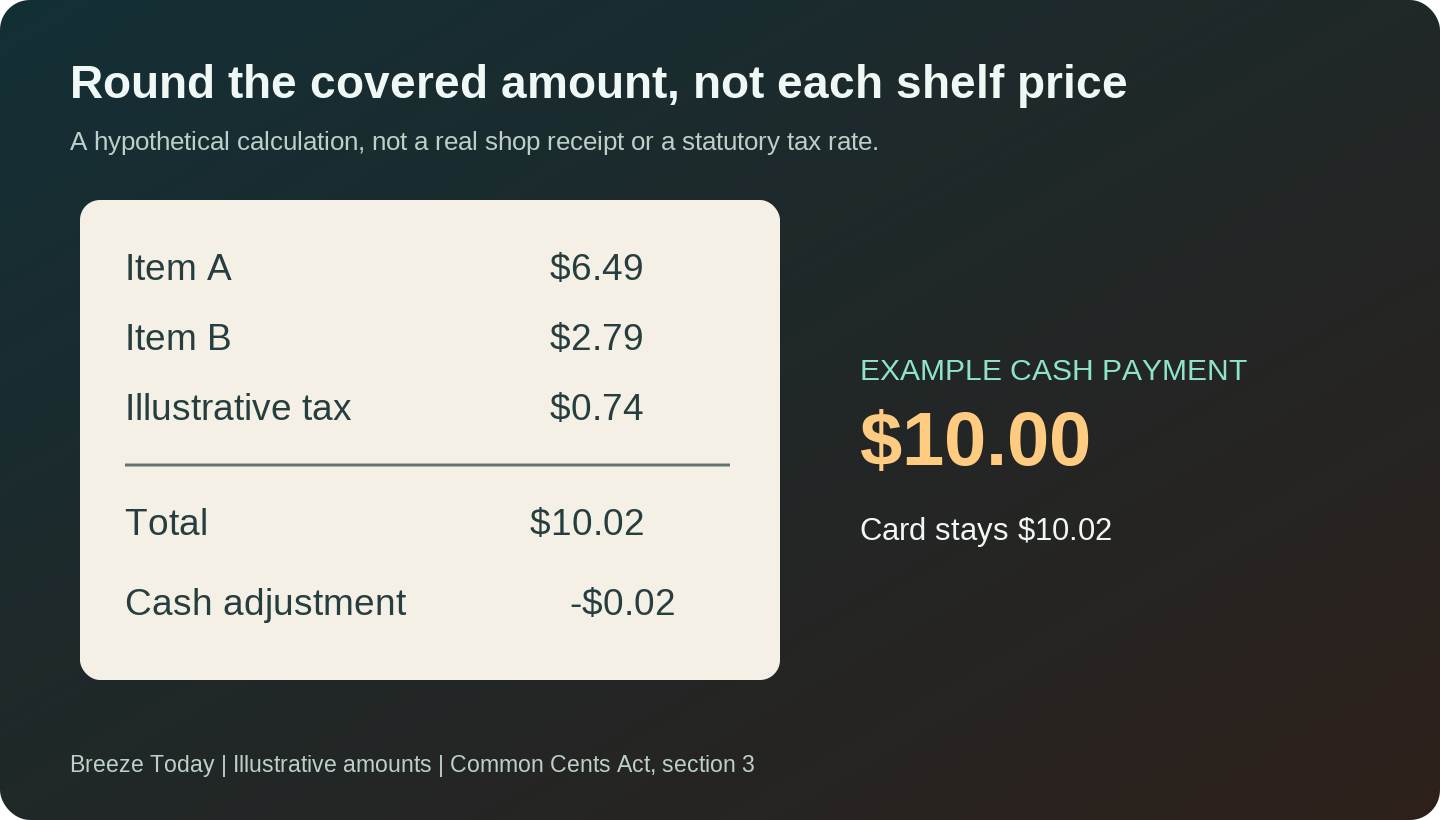
The definition of covered amount includes the total transaction amount, including taxes, or the change due when a customer hands over more cash than the tax-inclusive total. The important unit is therefore the relevant cash amount after the transaction has been calculated. Taxes are included in the total; this is not an instruction to calculate tax on an artificially rounded price. A receipt should distinguish the underlying calculation from any final cash adjustment.
Read the source US Government Publishing Office
How does nearest-five-cent rounding work?
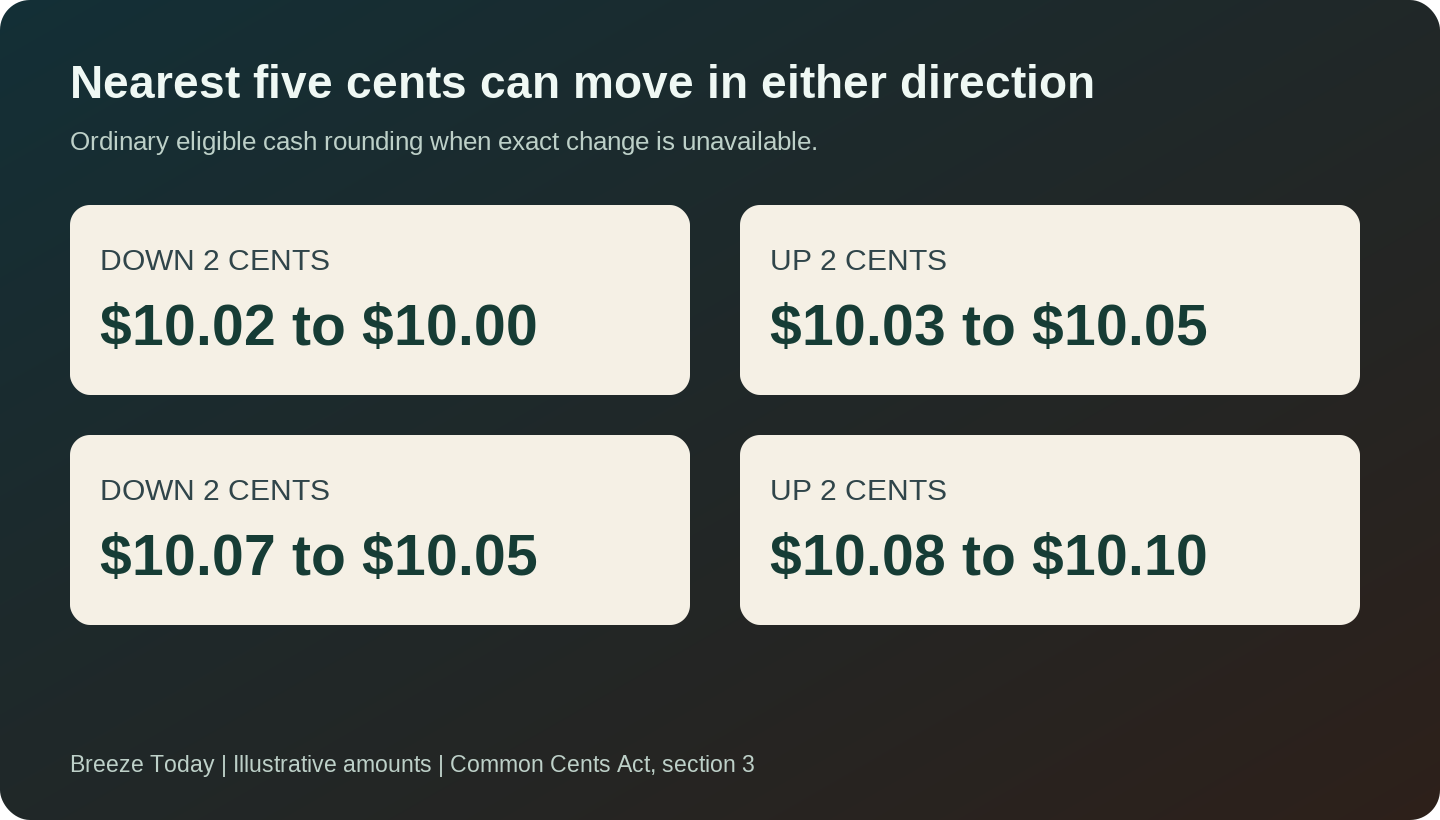
For ordinary eligible amounts, the last cent digit determines the nearest multiple of five. Digits 1, 2, 6 and 7 move down; digits 3, 4, 8 and 9 move up. An amount already ending in 0 or 5 is already a multiple of five and needs no adjustment under that calculation. These arithmetic examples describe the section 3(a) mechanism, not a requirement that every cash transaction use it.
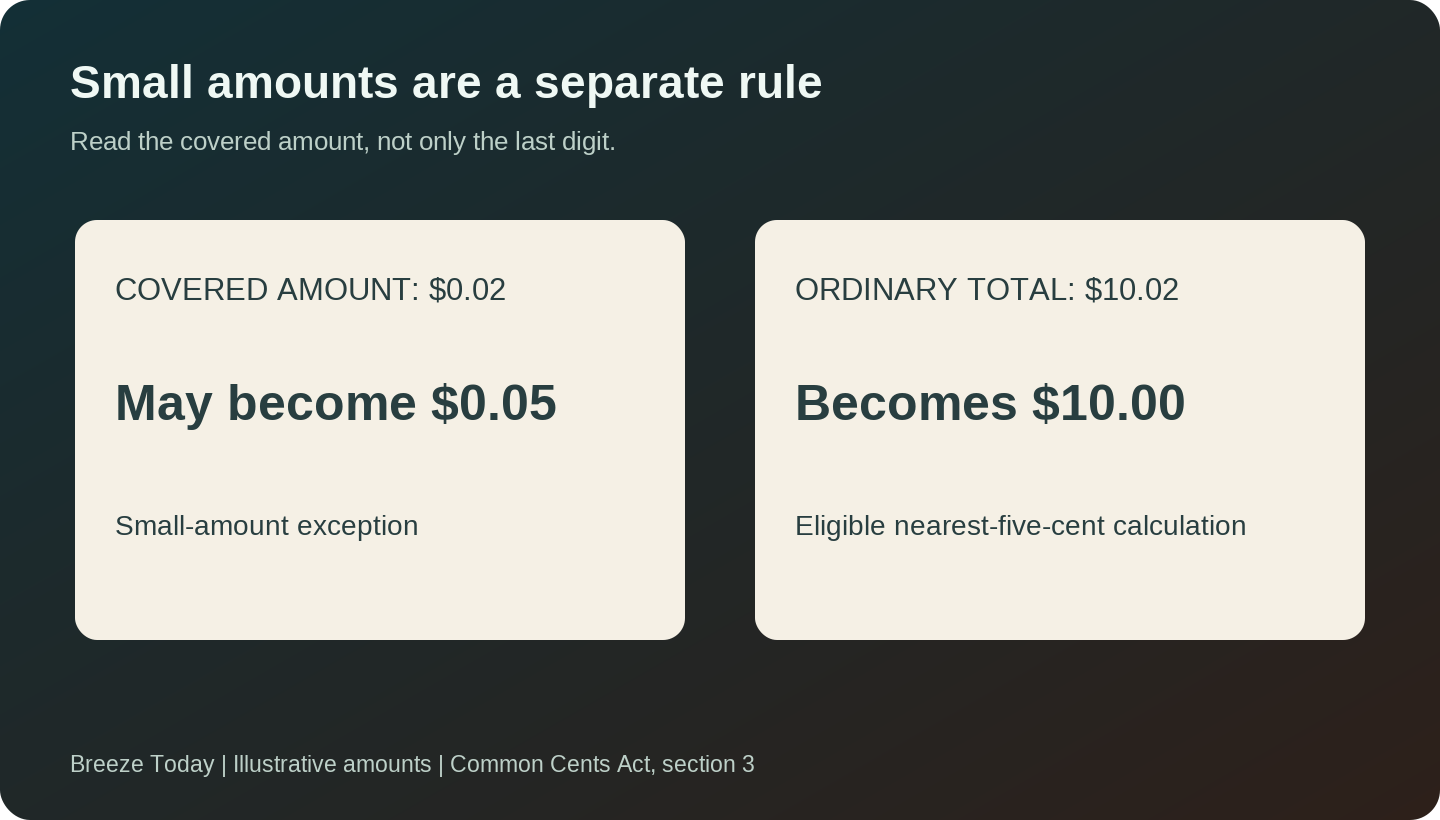
For example, a tax-inclusive total of $10.02 becomes $10.00, while $10.07 becomes $10.05. Both examples reduce the amount paid by two cents. In the other direction, $10.03 becomes $10.05 and $10.08 becomes $10.10. Both increase it by two cents. A $10.01 total would become $10.00; $10.04 would become $10.05. These examples do not establish that every customer breaks even over time: actual outcomes depend on the transactions and the rules applied.
Read the source US Government Publishing Office
Why are one-cent and two-cent amounts a special case?
The Act contains an explicit small-amount exception. A covered amount totaling just $0.01 or $0.02 may be rounded up to $0.05 for a person seeking to pay with cash. This is not the same thing as an ordinary $10.02 total. The first amount is two cents in its entirety; the second is ten dollars and two cents and follows the normal last-digit calculation when that mechanism applies.
The definition of covered amount also includes change due, so the exception should be read with that definition, rather than casually described as applying only to an entire purchase. This is one reason a short slogan about rounding all ones and twos down is incomplete. The examples here explain the statute; they do not substitute for the actual wording when a particular transaction has additional features.
Read the source US Government Publishing Office
What are customer-favorable rounding and the cash-wage rule?
Section 3(b) separately permits rounding in the customer's favor: up to a multiple of five when a person is paying the customer in cash, or down when the customer is paying that person in cash. This differs from ordinary nearest-five-cent rounding, which can benefit either side of an individual payment. The direction of the money transfer matters when describing who receives the benefit.
There is a further protection for employee payments. If an employer chooses to round a cash payment to an employee that is not already divisible by five cents, section 3(c) requires that chosen adjustment to go up. The subsection does not require an employer to round a payment made in an exact amount. Section 4 also states that the Act does not excuse noncompliance with minimum-wage, overtime or paid-leave requirements.
Read the source US Government Publishing Office
Do card, electronic, check or gift-card payments round?
No rounding authority for those methods is created by these cash provisions. Section 3(d) excludes transactions paid using instruments and methods including electronic fund transfers, checks, gift cards, money orders and credit cards. A card payment of $10.02 therefore remains $10.02 under this law, rather than becoming a $10.00 or $10.05 cash amount.
That cash-versus-noncash distinction is central to the checkout explanation. A diagram comparing the same total for a cash payment and a card payment is illustrating two payment methods, not announcing two different shelf prices. The law does not make every existing business pricing policy identical, and these provisions should not be presented as a universal claim about all fees or all other payment laws.
Read the source US Government Publishing Office

What does the law say about other rules and future coin changes?
Section 4 gives federal, state and tribal legal protections for conduct adhering to section 3's cash-rounding provisions. This is more specific than saying all state rules disappear. The protection concerns adherence to the statutory rounding framework, with the express labor-law qualification described above. Reading that scope accurately avoids turning a cash-calculation rule into an unsupported claim about every consumer dispute.
The Act also permits a potentially lower-cost nickel composition with a zinc inner layer and nickel outer layer, subject to testing and evaluation of cost and effects on coin-accepting machines. Authorization is not evidence that a new nickel is already being produced or circulating. Another provision creates advance-notice and briefing procedures for discontinuing other covered circulating coins. Those are separate issues from whether a cash receipt today rounds up or down.
Read the source US Government Publishing Office
Who could be affected, and what evidence comes next?
People relying on cash have a direct reason to care about how the adjustment is applied and recorded. The statute requires a Federal Reserve strategic plan and report on coin-terminal operations and penny distribution stability within 90 days of enactment. It also includes a Treasury assessment of disruptions and check-cashing rounding, with attention to low-income communities, older consumers and debanked, unbanked and underbanked people.
These reporting requirements acknowledge questions that need evidence. They do not establish that every household will save a particular amount, that rounding is automatically neutral for everyone or that a specific pictured shop has changed its practices. Future agency reports can help assess implementation and any adverse effects. A reduction in the cost of minting a coin is a different question from the distribution of small cash adjustments across consumers.
Read the source US Government Publishing Office

What should readers look for on a cash receipt?
The most useful distinction is between the original tax-inclusive total, the cash amount or change being adjusted, and the resulting amount actually exchanged. A final adjustment of one or two cents can be consistent with nearest-five-cent rounding, but the direction and the applicable rule still matter. An example showing a downward adjustment should not be used to imply that every payment rounds down, just as an upward example does not prove every payment rises.
The central takeaway is straightforward: existing pennies remain money, ordinary eligible nearest-five-cent rounding can go either way, customer-favorable and cash-wage provisions have their own directions, and noncash payments are excluded from these cash rules. This article was checked against the enrolled Act, the signing confirmation and independent reporting on November 21, 2026. The photographs and stock recordings are labeled context, not footage of a new-law transaction.
Read the source US Government Publishing OfficeWhite HouseMark Schoeff Jr / CQ Roll Call
Work through a complete bill and the cash change
Use a hypothetical bill of $13.37 after taxes and a $20 cash payment. If the relevant circumstances allow rounding and the total is rounded to the nearest five cents, $13.37 becomes $13.35. The change is then $6.65. For a $13.38 bill, nearest-five-cent rounding gives $13.40 and $6.60 in change. These examples illustrate the arithmetic; they do not make rounding mandatory.
The law also defines the covered amount to include the amount of change due when the cash payment exceeds the total. In the first example, the unrounded change would be $6.63. Rounding that change to $6.65 reaches the same net payment of $13.35. It is important to identify which covered amount is being adjusted so the transaction is not treated as two unrelated opportunities to change the price.
Keep a separate eye on the very small total exception described earlier. Applying the familiar final-digit mnemonic mechanically to an entire transaction of one or two cents would miss that provision. The direction of payment also matters for the employer-payment and customer-favorable provisions. A single nearest-five-cent slogan is therefore less precise than the text it summarizes.
Read the source US Government Publishing OfficeHouse Financial Services Committee
Why rounding each line item is a different calculation
Imagine two hypothetical charges of $0.43 and $0.44 that make a final covered bill of $0.87, with any relevant taxes already accounted for. Nearest-five-cent rounding of that total gives $0.85. Rounding the two displayed amounts separately to $0.45 and $0.45 would instead give $0.90. Those are different calculations because rounding is not additive.
The example explains why the article focuses on the covered amount defined in the law, rather than rewriting every shelf price to a multiple of five cents. The payment method and availability of exact change are also part of the circumstances. A story about cash settlement should not silently become a claim that electronically paid prices or individual product prices must all change.
For a receipt, the useful distinction is between the original amount, an identified cash adjustment and the resulting cash paid or change returned. Those figures let a reader reconstruct the arithmetic. They are more informative than a bare statement that the penny disappeared, which also conflates the manufacturing history of the coin with the rules governing a particular transaction.
Read the source US Government Publishing OfficeUS Mint
A little more clarity
Questions, answered
Must every cash transaction round under this law?
No. The text expressly says the relevant provisions do not require a person to round a payment. The nearest-five-cent permissions also sit within specified circumstances, including the inability to provide exact change for the general rule. The worked examples show how an eligible adjustment is calculated, rather than instructing every seller or customer to round.
Do the examples mean card payments are rounded too?
No. The law distinguishes the covered cash rules from listed noncash methods, including electronic transfers, checks, gift cards and credit cards. This article's rounding calculations concern the cash provisions. The hypothetical bill amount and the cash-settlement adjustment should not be treated as a general new price for every payment method.
US Government Publishing OfficeHouse Financial Services Committee
Why can the same basket give a different answer if its items are rounded first?
Rounding changes the inputs before they are added. Adding first and rounding the final covered amount is therefore not always equivalent to rounding each line and then adding. The $0.43 plus $0.44 example demonstrates the difference. It is a mathematical explanation of why the defined transaction amount matters, not evidence of a particular shop's pricing behavior.
Follow the evidence
Sources and reporting
The original reporting date is shown above. These sources support the reported event and the additional explanatory context; a party’s statement is identified separately from an independent account.
- Enrolled Common Cents Act, H.R.10167US Government Publishing Office
- White House signing confirmationWhite House
- Trump signs bill to halt penny productionMark Schoeff Jr / CQ Roll Call
- Penny FAQsUS Mint
- Final circulating penny ceremony, November12,2025US Mint
- House committee signing statementHouse Financial Services Committee
Images, footage and media credits 7 credits
Older coin photographs and licensed 2021/2022 stock recordings are contextual, not footage of the 2026 signing or evidence that a pictured business has implemented the Act. Receipt and comparison diagrams are original illustrations of the statutory arithmetic, not actual transactions.
- US dollars changing hands at marketKindel Media. Pexels License, item displays Free. Muted source audio; selected intervals, crop/scale/background, captions and illustrative annotations.
- Cashier counting US dollar bills and coinsMizuno K. Pexels License, item displays Free. Muted source audio; selected intervals, crop/scale/background, captions and illustrative annotations.
- Boutique card-payment contextMART PRODUCTION. Pexels License, item displays Free. Muted source audio; selected intervals, crop/scale/background, captions and illustrative annotations.
- Grocery card-payment contextKampus Production. Pexels License, item displays Free. Muted source audio; selected intervals, crop/scale/background, captions and illustrative annotations.
- Counting small change at table; currency not identified, generic cash-handling context onlyDziana Hasanbekava. Pexels License, item displays Free. Muted source audio; selected intervals, crop/scale/background, captions and illustrative annotations.
- Older Lincoln penniesPhotos Public Domain. Original site explicitly releases all photographs into public domain, any use including commercial.. Crop, slow reframe and scene background; not new 2026 coin design.
- Authentic enrolled legislationUS Government Publishing Office / Congress. US federal legislative text, public domain. Page rasterized/cropped, original document unchanged.