Distance, delay and missing data
Voyager 1 Reaches One Light-Day: Why Its Signal Takes 24 Hours
Voyager 1 reached one light-day from Earth in November 2026. Understand the 24-hour signal delay, missing telemetry, interstellar boundary and power limits.
What has Voyager 1 actually achieved?
Voyager 1 crossed a distance of one light-day from Earth on November 18, 2026. NASA confirmed the milestone on November 19 after the spacecraft's carrier signal completed its day-long journey back to the mission team. It is the first human-made object to reach that distance from Earth. The event marks nearly 50 years of travel since the probe's September 1977 launch.
The distinction between reaching the distance and receiving confirmation matters. Earth-based controllers cannot observe the spacecraft's present condition instantaneously. At this range, an arriving radio signal describes what was transmitted about a day earlier. The confirmation therefore followed the crossing, rather than happening at the same moment.
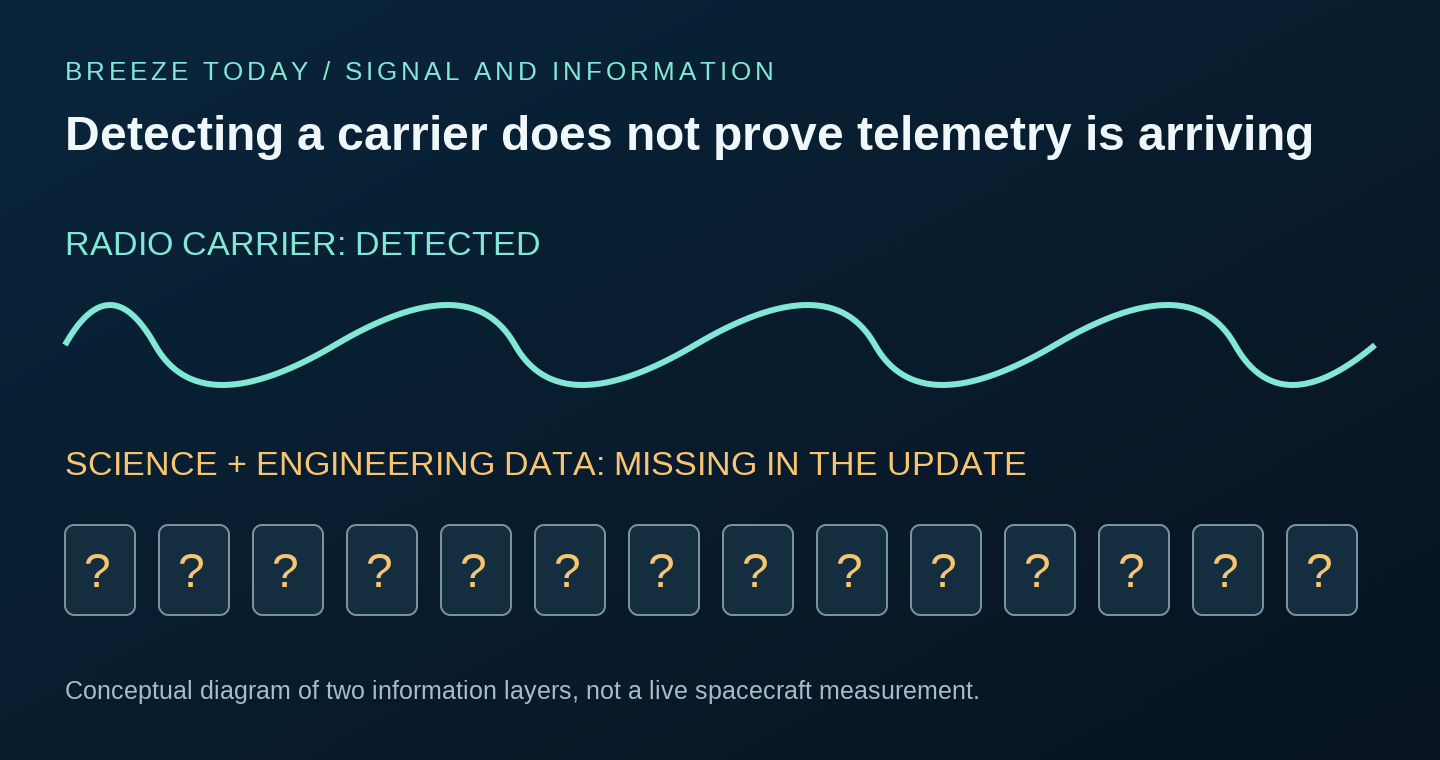
There is also a qualification that celebratory summaries can miss. NASA's November 19 release says Voyager 1 has not returned science and engineering data since November 14. Engineers used the detectable carrier and trajectory calculations to confirm the milestone. That confirms the distance; it does not establish that the separate data problem has been repaired.
Read the source NASANASA mission update
How far is one light-day in kilometers and miles?
A light-day is a unit of distance: the distance light travels in a vacuum during 24 hours. It is approximately 25.9 billion kilometers, or 16.1 billion miles. The name uses a familiar period of time to express an otherwise unwieldy distance. It does not mean Voyager completed its trip in a day, or that it travels at the speed of light.
The basic calculation is distance equals speed multiplied by time. Light travels at about 300,000 kilometers per second. Multiply by the 86,400 seconds in a day and the result is roughly 26 billion kilometers. The rounded values explain the scale; NASA's mission calculations establish the actual crossing. Small differences between rounded figures are not evidence that a different milestone occurred.
A light-year is much larger: it represents a year of light travel, rather than a day. A claim that Voyager has reached one light-year would describe a completely different distance. The current milestone is one light-day. Keeping those units straight is essential when reading short headlines and social posts.
Read the source NASANASA Scientific Visualization Studio
See the distinction
Read a Voyager communications update in layers
| Observation | What it establishes | What it does not establish |
|---|---|---|
| One light-day distance | About one day of one-way radio travel | An instant or continuous live view |
| Detected carrier | A detectable radio transmission | Complete decoded telemetry |
| Engineering telemetry | Reported measurements at transmission time | An immediate view of the present |
| Two-way exchange | Command travel plus response travel | No additional operational delay |
Why does a command and reply take about 48 hours?
Radio waves and visible light are forms of electromagnetic radiation. Both travel at the speed of light in a vacuum. Choosing a radio link instead of a visible beam does not make the information travel faster. The communications delay comes from the enormous distance, rather than a slow internet connection that engineers could simply upgrade.
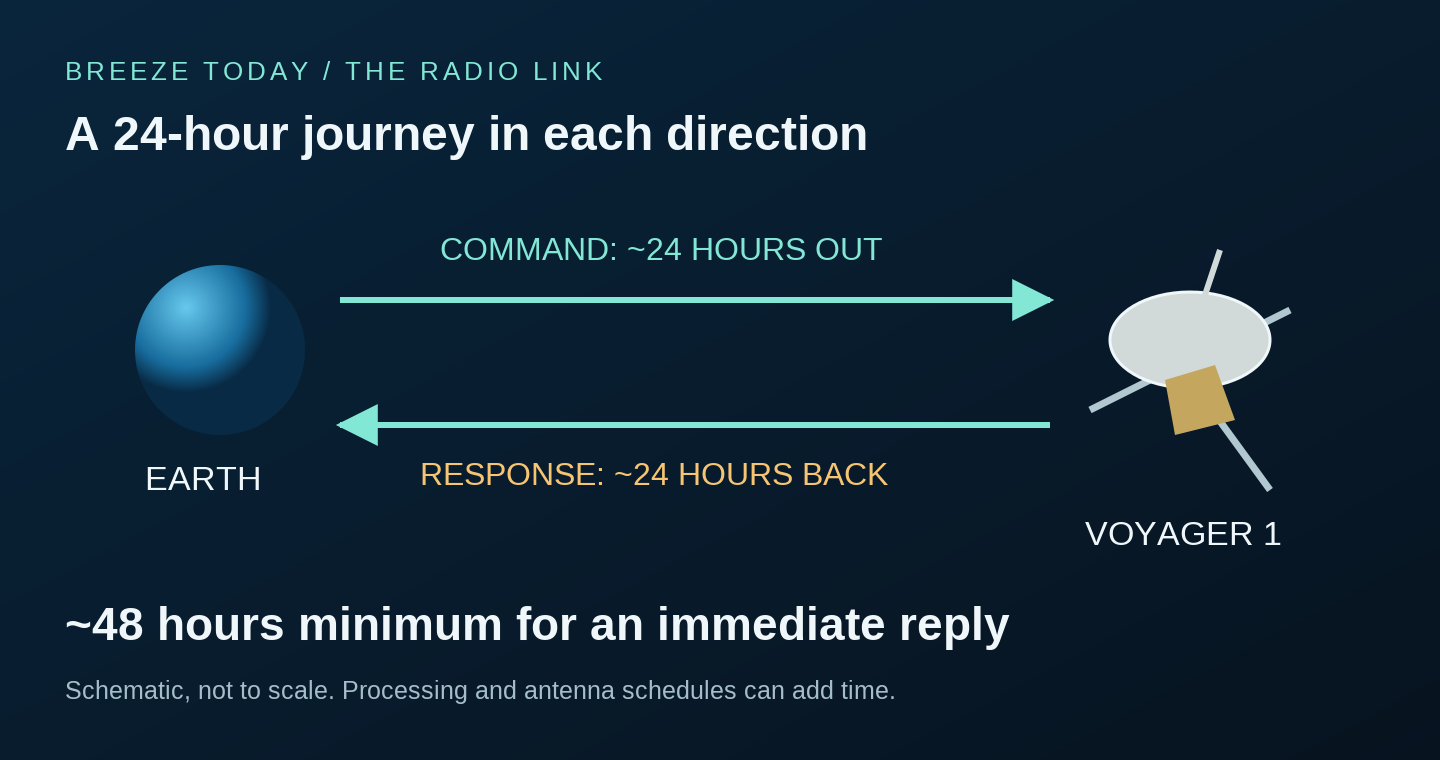
A command sent from Earth needs about 24 hours to reach Voyager 1 at the milestone distance. A response then needs about another 24 hours to reach Earth. Even if the spacecraft acted and answered immediately, the team would wait roughly 48 hours to see that answer. Real operations can add time for processing, antenna schedules, analysis and deciding what to try next.
That is a minimum round-trip explanation, rather than a promise that every diagnostic test finishes exactly two days later. A failure investigation can require several command-and-response cycles. NASA says diagnosing the present data problem could take weeks or longer. Engineers must plan carefully because a mistaken command cannot be corrected through a rapid conversation.
Read the source NASA mission updateNASA Goddard Space Flight Center
How can a signal arrive without useful spacecraft data?
A radio carrier is the underlying signal used to transport information. Detecting it is different from recovering the science measurements and engineering telemetry that should travel with it. An everyday comparison is detecting that a transmitter is on without receiving a usable message. The comparison explains the distinction; Voyager uses specialized deep-space communications equipment, not a household radio.
NASA reports that the missing data suggest an issue involving the onboard computer responsible for collecting information from subsystems and formatting it for transmission. That is a reported diagnostic lead, not a confirmed cause. The carrier indicates that important parts of the pointing and broadcasting system are still functioning, while the team investigates the missing information.
The mission experienced a similar broad symptom in 2023, but a similar symptom does not establish the same fault. The team is drawing on earlier experience and is also investigating whether the present issue relates to a brief October communications gap. Neither a causal connection nor a successful repair should be assumed until a subsequent mission update establishes it.
Read the source NASA mission update
What did Voyager 1 and Voyager 2 do before interstellar space?
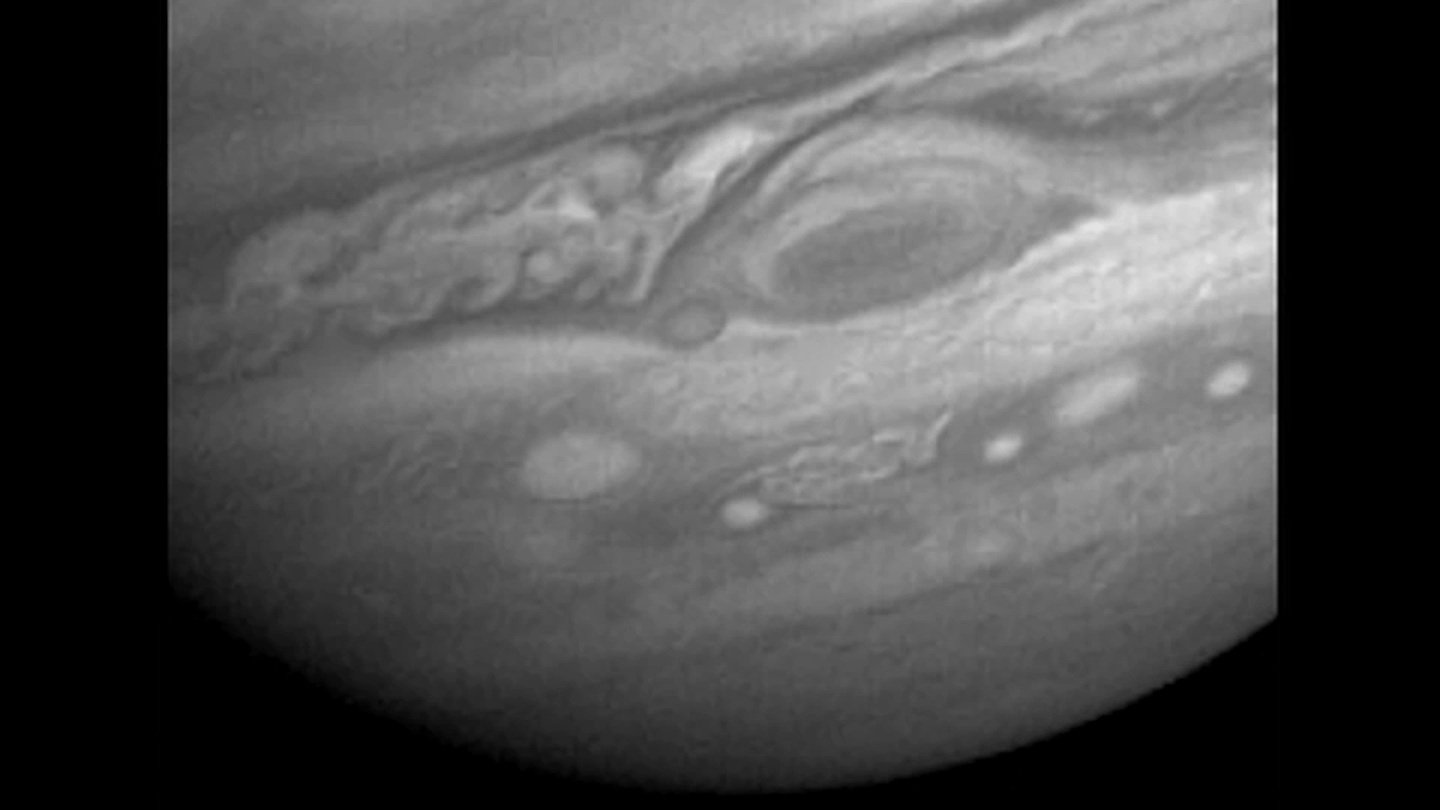
The two probes launched in 1977 for close studies of the giant planets. Voyager 2 launched first, in August. Voyager 1 launched in September on a faster, shorter route and encountered Jupiter in 1979 and Saturn in 1980. Both spacecraft made important observations at those planets, while Voyager 2 continued on to Uranus and Neptune.
The different routes matter. Images of a Voyager encounter with Neptune belong to Voyager 2's journey, not a visit made by Voyager 1. The shared mission transformed knowledge of planetary atmospheres, moons, rings and magnetic environments. Its value was established well before the later distance records and interstellar measurements.
The spacecraft were originally designed for a five-year mission. Remote reprogramming, careful engineering and extensions of the planetary tour allowed the broader mission to continue. Their longevity is an achievement of the people operating aging hardware, rather than a reason to assume that future operations will be trouble-free.
Read the source NASA
Does interstellar space mean Voyager left the entire solar system?
Voyager 1 crossed the heliopause in 2012. The heliopause is the outer boundary of the heliosphere, the bubble produced by the Sun's outward-flowing solar wind and magnetic environment. Crossing it put the spacecraft in the surrounding interstellar medium, where it can investigate particles, plasma waves and magnetic fields in a previously unexplored region.
That boundary is not the same as the outer limit of every influence exerted by the Sun. The Sun's gravitational reach extends much farther. It is therefore misleading to treat the heliopause as a single universal border that contains every definition of the solar system. A useful explanation states which physical boundary is meant.
Nor is this region simply empty space with nothing left to study. The mission investigates how conditions change beyond the solar-wind bubble, including the extent of the Sun's effects there. Voyager 2 crossed the heliopause in 2018 along a different trajectory, giving scientists a second path through that environment.
What keeps Voyager powered so far from the Sun?
Voyager does not depend on solar panels for its operating electricity. Radioisotope thermoelectric generators convert heat from radioactive decay into electrical power. That arrangement made long journeys far from sunlight possible, but it is not an unlimited energy supply. Available electrical power declines as the systems age.
NASA describes ongoing efforts to conserve energy, including turning equipment off and substituting lower-power operating arrangements. Those choices involve trade-offs: the team wants to maintain useful science while protecting essential spacecraft functions. The existence of a power-saving plan does not guarantee a particular future mission lifetime.
Power and communications also describe different constraints. Conserving electricity helps keep equipment available; it does not remove the light-travel delay. Recovering telemetry can help engineers understand a fault; it does not restore the spacecraft's original power supply. Treating the limits separately makes subsequent updates easier to interpret.
What should readers watch for next?
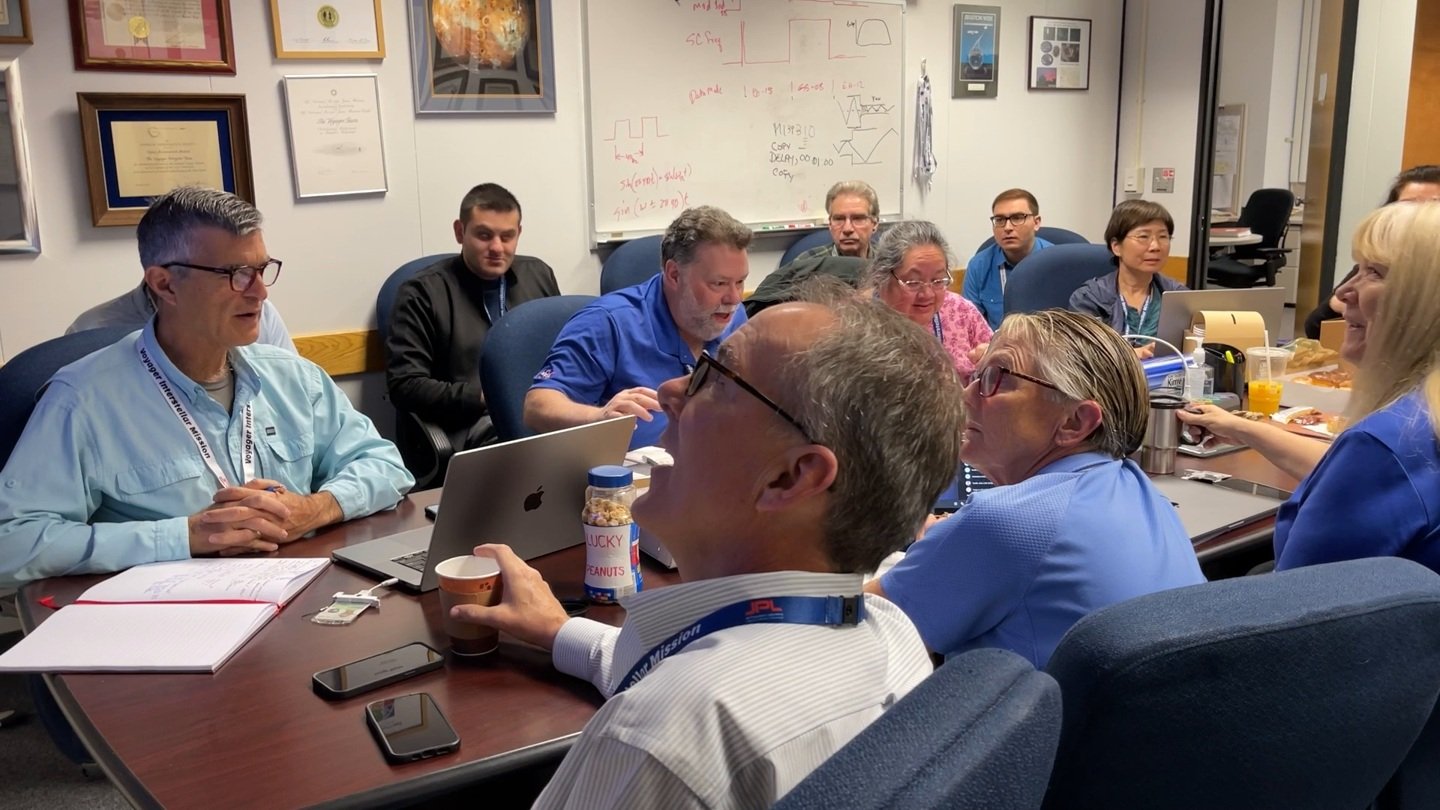
The key operational question is whether Voyager 1 resumes returning useful science and engineering data. Look for a dated mission update that describes what was received, what engineers concluded and which systems are working. A strong carrier, a new distance figure and a successful telemetry recovery answer different questions.
The mission team is continuing its investigation, and its confidence or hopes should remain attributed to the people expressing them. Space.com's reporting from the November 19 celebration records both the team's enthusiasm and the continuing anomaly. That is a more complete account than either declaring Voyager dead or treating the milestone as proof of full health.
The milestone also prompted a visible celebration closer to home. NASA photographed New York's Empire State Building illuminated in gold on November 17. A November 19 NASA message from astronaut Jessica Watkins aboard the International Space Station linked the nearby orbiting outpost with Voyager's much more distant journey. Those celebrations recognize the achievement; they do not resolve the separate telemetry anomaly.
The one-light-day record is a confirmed achievement. The data problem is an ongoing engineering challenge. Together they explain why the mission is remarkable: humans are still trying to operate and learn from a spacecraft whose answer needs a day just to travel home. This article reflects the November 19 confirmation and November 18 mission-status report; newer operational claims require a fresh mission update.
Read the source NASANASA mission updateChelsea Gohd / Space.comNASA / Bill IngallsNASA Johnson Space Center / NASA/JPL-Caltech

A command-and-response example on a mission clock
Imagine a simplified mission clock: Earth sends a command at noon on day one. If the one-way light time is exactly 24 hours, the spacecraft receives it at noon on day two. An immediately transmitted acknowledgement would then reach Earth at noon on day three. Those are illustrative clock labels, not the actual timestamps of a Voyager command.
The example separates two waits that are easy to merge. First, the command must reach the probe. Then the response must return. Processing, transmission scheduling and analysis on the ground can add time beyond that minimum. A roughly 48-hour light-time round trip therefore does not promise a completed engineering diagnosis every two days.
It also changes the meaning of a status measurement. A temperature or voltage reported in a newly received transmission describes the spacecraft when that transmission was sent. Engineers must reason about a remote system with delayed evidence, rather than interact with it as though a live dashboard showed its immediate present.
Read the source NASANASANASA mission update
Distance, signal strength and useful information are different questions
A stronger radio signal and a shorter radio journey are not the same improvement. Better receiving equipment can help detect a weak transmission, but it cannot make that transmission cross the same distance faster than light. The light-day milestone describes propagation time; a link's strength and the information recovered from it are separate issues.
A useful way to read a mission update is to ask three questions in order. Was a signal detected? Was the transmission decoded into usable engineering or science data? What does that data establish about the spacecraft? The November 19 account cited in this report distinguished a detectable carrier from the missing telemetry. It should not be flattened into either normal operations or complete silence.
The historical context matters too. Voyager's planetary encounters, entry into interstellar space and continued communications are different achievements. The new distance headline does not replace that history or make every boundary of the solar system the same boundary. Read each claim against the specific distance, instrument observation or engineering evidence used to establish it.
A little more clarity
Questions, answered
Would a more powerful transmitter remove the one-day delay?
No. More power can affect how readily a signal is detected, but it does not change the speed at which radio waves propagate across a given distance. At a distance of one light-day, the one-way travel time is about a day. Signal detectability, decoding and propagation time should be kept separate when reading a communications update.
Does hearing a carrier mean all Voyager instruments are working?
No. Detecting the carrier establishes something about the communications link, not a complete inventory of instrument health. Useful engineering and science telemetry would support further conclusions. This distinction is central to NASA's November 19 report: the distance milestone and the data-return problem were reported together, rather than one cancelling out the other.
Is a light-day a speed or a distance?
It is a distance: how far light travels in a day. The phrase also makes the associated signal delay intuitive. It does not mean Voyager itself travels one light-day each day. The spacecraft's motion and the travel speed of the radio signal are different quantities, even though both appear in discussions of its distance from Earth.
Follow the evidence
Sources and reporting
The original reporting date is shown above. These sources support the reported event and the additional explanatory context; a party’s statement is identified separately from an independent account.
- NASA confirms Voyager 1 one-light-day milestoneNASA
- Voyager 1 engineers analyze data issueNASA mission update
- Voyager fact sheetNASA
- Voyager interstellar missionNASA
- Voyager team celebrates milestone despite communications glitchChelsea Gohd / Space.com
- One light-day visual resourcesNASA Scientific Visualization Studio
- Original Joe Westlake interview and mission b-rollNASA Goddard Space Flight Center
- Voyager antenna construction, July 9, 1976NASA Image and Video Library
- Empire State Building Voyager milestone photograph, November 17, 2026NASA / Bill Ingalls
- Jessica Watkins: ISS message for Voyager, November 19, 2026NASA Johnson Space Center / NASA/JPL-Caltech
Images, footage and media credits 7 credits
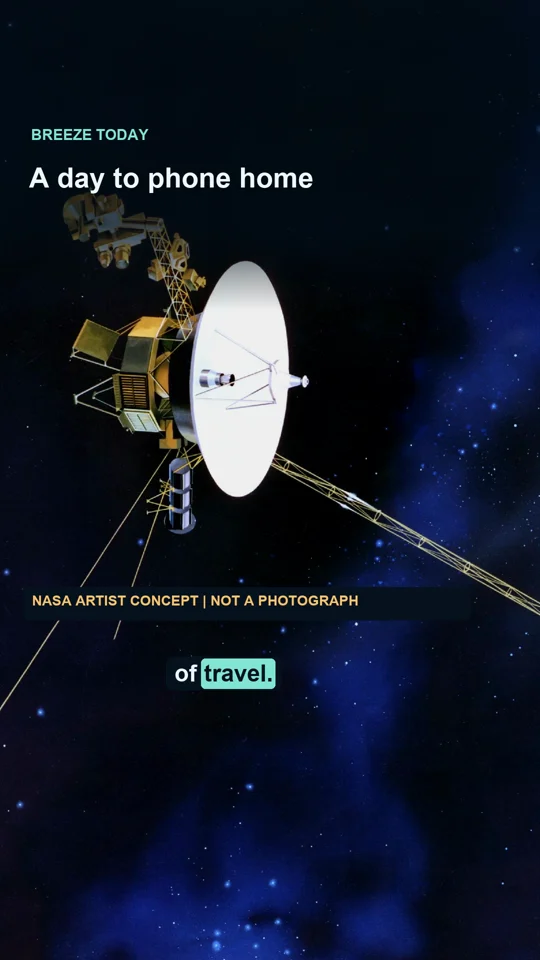
The spacecraft cover is a labelled NASA artist concept. Historical mission and engineering imagery remains dated context. Archive footage does not establish that the current telemetry issue has been fixed. Original diagrams explain physical relationships and do not represent live spacecraft measurements.
- Courtesy NASA/JPL. NASA informational/editorial use. Resized/cropped from PIA04495; artist-concept context retained. No endorsement implied.
- Joe Westlake original November 2026 interview and NASA Voyager b-rollNASA's Goddard Space Flight Center. NASA informational/editorial use. Original Westlake speech excerpt and historical article Jupiter frame; other source audio excluded. Historical observation context retained.
- Voyager launch and integration archiveCourtesy NASA/JPL-Caltech. NASA/JPL editorial use. Selected dated launch/integration excerpts, portrait layout; source audio excluded.
- Voyager engineering team, April 2024Courtesy NASA/JPL-Caltech. NASA/JPL editorial use. Extracted article frame from the dated archive recording; source audio excluded and no current-fix implication.
- Jessica Watkins: ISS message for Voyager, published November 19, 2026NASA/JPL-Caltech / NASA Johnson Space Center. NASA informational/editorial use. Selected contextual source recording and original voice. NASA's source edit includes ISS imagery and labelled spacecraft animation. No endorsement implied.
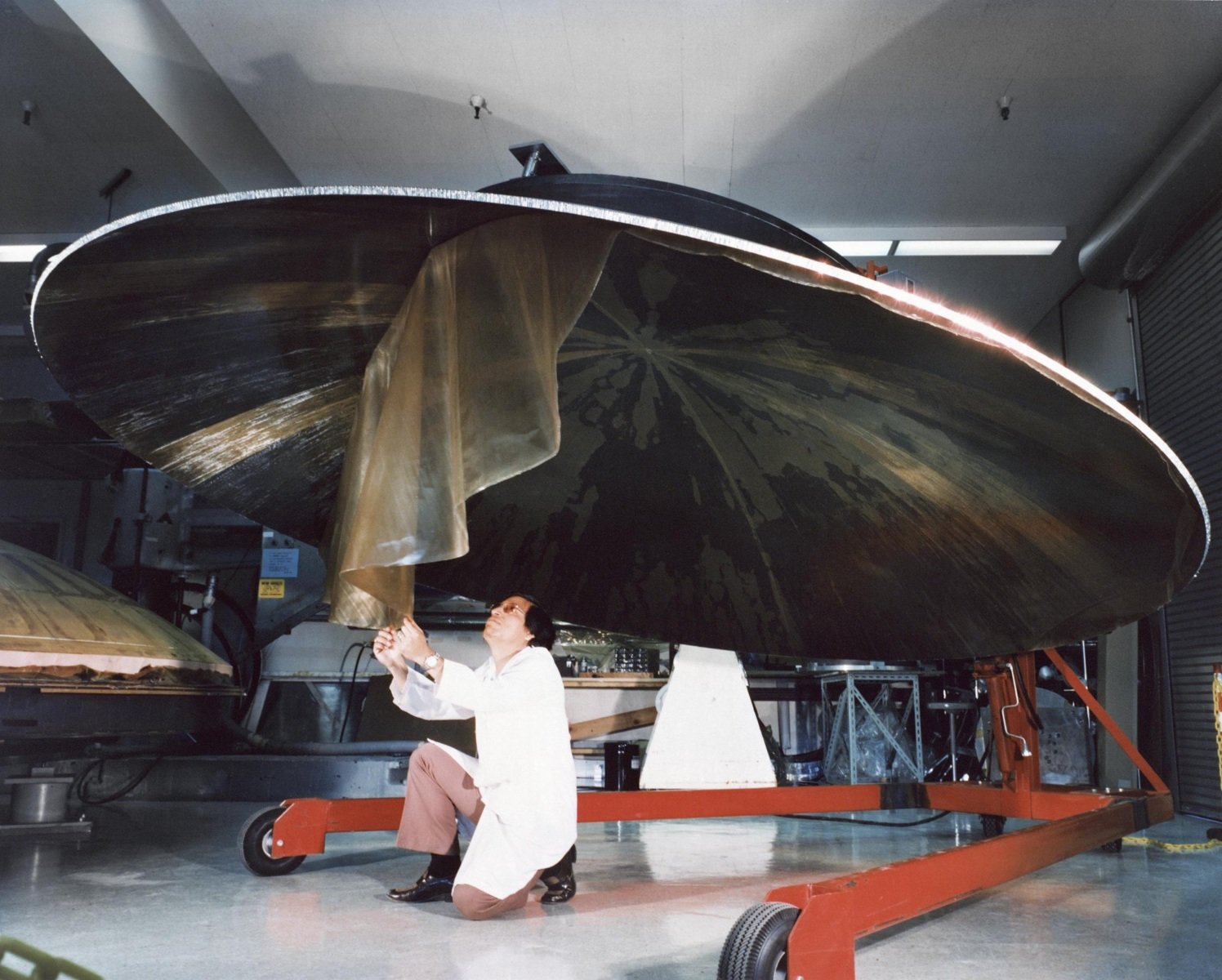
- Construction of a Voyager high-gain antenna on July 9, 1976. Dated hardware context, not an image of current fault diagnosis.Courtesy NASA/JPL-Caltech. NASA/JPL editorial use. Resized and JPEG encoded; archival date retained.
- The Empire State Building glowed gold for the Voyager milestone on November 17, 2026, viewed from SUMMIT One Vanderbilt.NASA/Bill Ingalls. NASA informational/editorial use. Resized and JPEG encoded; source context and date retained.