From a claim to formal checks
Riemann Hypothesis AI Proof: What the New Lean Verification Establishes
Lean and Mathlib endorsed the AI-assisted Riemann Hypothesis proof. Understand the exact claim, independent checks, prime-number link and limits.
What changed after the original Riemann proof announcement?
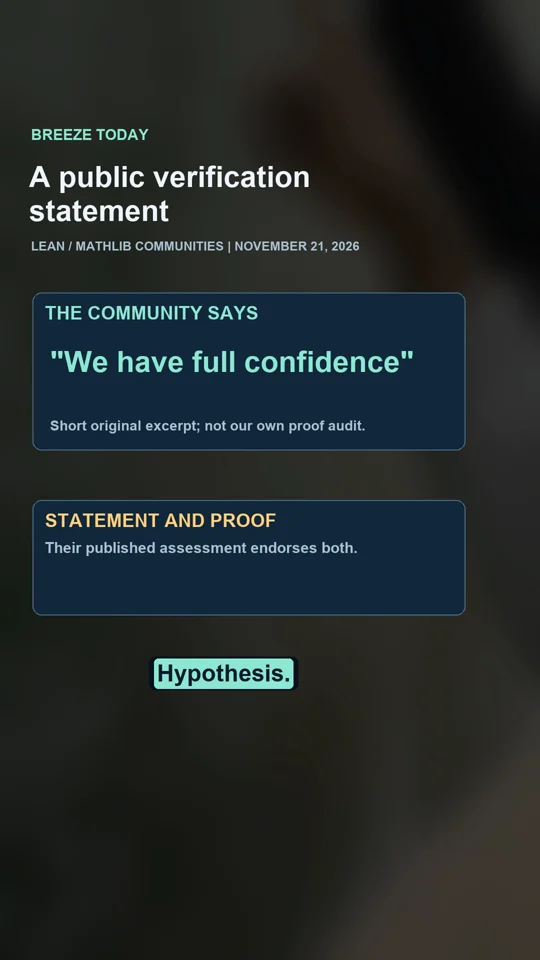
On November 21, 2026, the Lean and Mathlib communities issued a joint statement expressing confidence in both the statement and the proof of the Riemann Hypothesis released by Levent Alpoge. The endorsement is a material development beyond the original announcement. It shifts this story from an individual claim awaiting checks to a public assessment backed by reported formal-verification work. That assessment is attributable to the communities that issued it; this article is not an independent rerun of the complete proof.
The distinction matters because the story developed quickly. Early reporting described checks that had not yet finished. A later community assessment and a continuously updated verification table can therefore contain information that an earlier news article did not have. Readers should compare the actual timestamp and the scope of each record. A source saying a particular job is still running does not, by itself, undo a result reported by a different completed check.
Read the source Lean / Mathlib communitiesAndrew Sutherland / MITKonstantin Kakaes / Quanta Magazine
Who made the claim, and what was released?
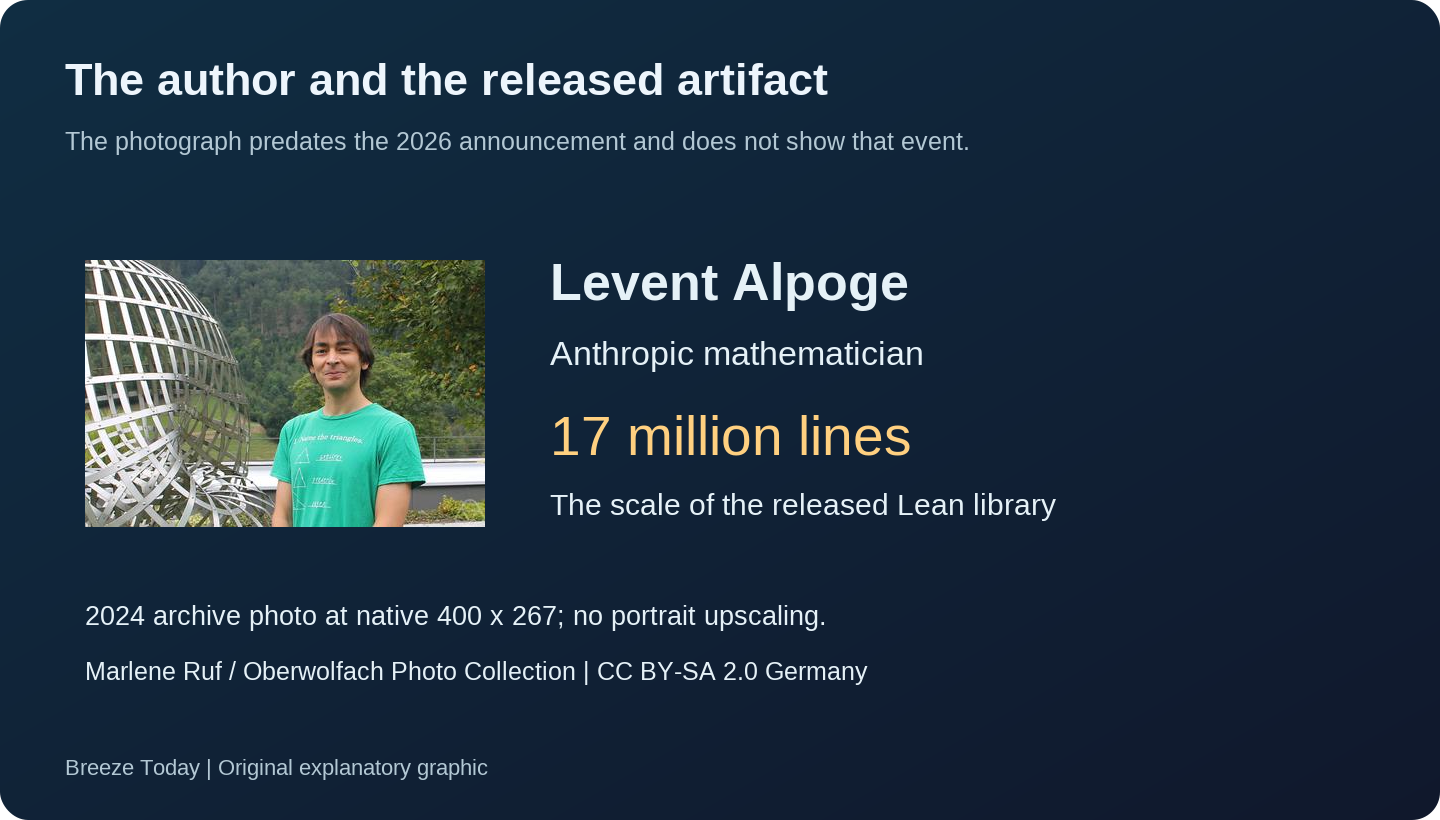
Alpoge, a mathematician working at Anthropic, announced on November 20 that he had developed a proof with Claude. The release took the form of a large Lean development, described as about 17 million lines of code, together with a short explanatory announcement. Independent original reporting by the Associated Press and Quanta covered the claim and the checking efforts that followed. The present article focuses on the subsequent verification development rather than treating the announcement as new again.
A line count conveys the size of the artifact, not the strength of its mathematics. A large program can contain repetition, generated infrastructure and many intermediate results. A small program can also contain a mistake. The relevant questions are what proposition the final theorem expresses, whether the argument satisfies the proof system, what assumptions it uses, and whether other people can reproduce the checks. Calling an artifact enormous answers none of those questions on its own.
Read the source Levent AlpogeAssociated PressKonstantin Kakaes / Quanta Magazine
See the distinction
Separate the layers of a formal-verification claim
| Question | Relevant evidence |
|---|---|
| Does the project build? | A reproducible build of an identified version. |
| Is it the intended theorem? | Comparison with the vetted mathematical statement. |
| Was the proof independently checked? | The stated independent checks and their trust assumptions. |
| Can mathematicians explain the ideas? | A readable mathematical account. |
| Has a prize been awarded? | A separate statement from the awarding institution. |
What are prime numbers, and why do they matter here?
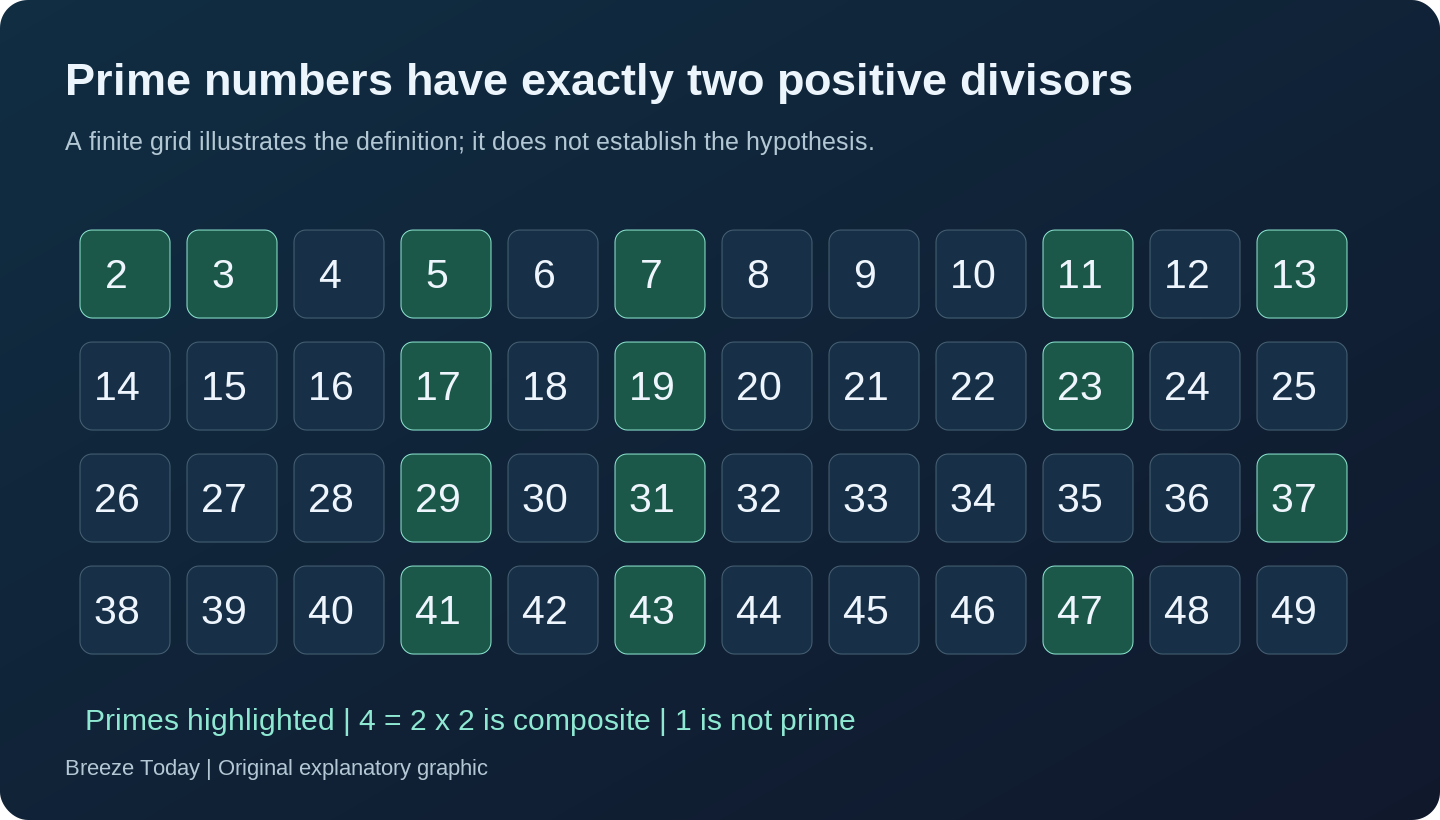
A prime is a whole number greater than one with exactly two positive divisors: one and the number itself. Thus 2, 3, 5 and 7 are prime. Four is composite because it equals 2 times 2, and six is composite because it equals 2 times 3. One is not prime: it does not have two distinct positive divisors. These simple examples separate the definition from the much harder question of how primes are distributed as numbers grow.
Primes do not appear at evenly spaced intervals. For instance, the gap from 3 to 5 is 2, while the gap from 7 to 11 is 4. Yet an uneven local pattern can still have a mathematical description at larger scales. The Riemann Hypothesis is important because it would sharpen understanding of the relationship between that distribution and a complex-valued function. The prime grid below is an original finite illustration, not evidence that a statement about all primes or all zeros has been proved.
Read the source Clay Mathematics Institute
What does the Riemann Hypothesis actually say?
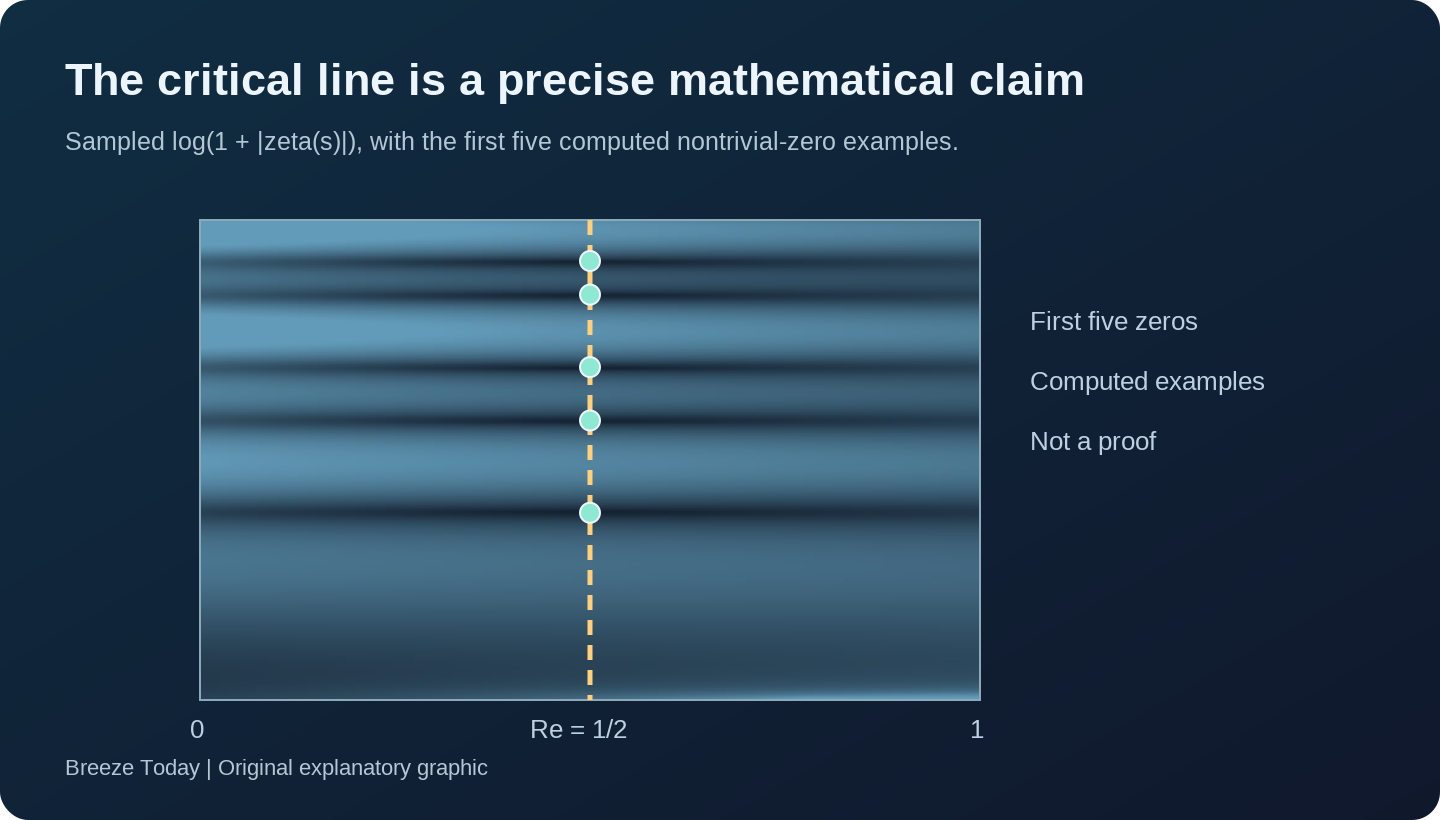
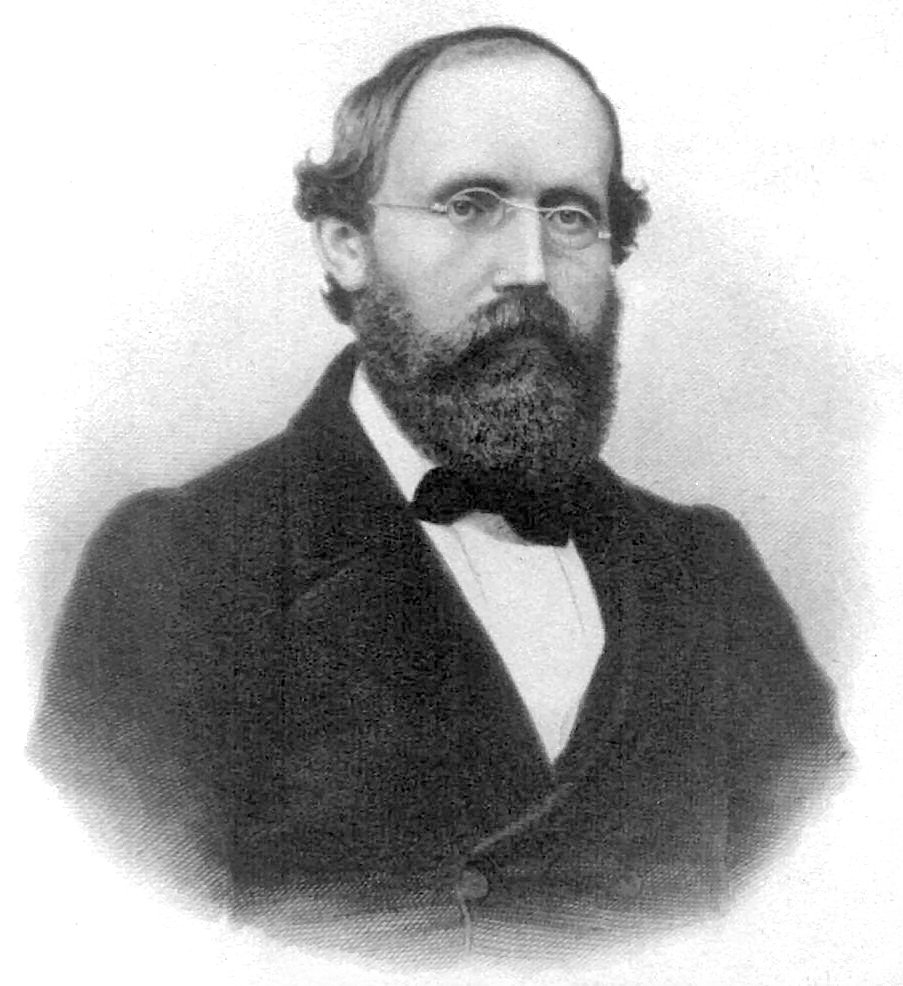
Bernhard Riemann connected prime-number questions with the behavior of the zeta function. The hypothesis concerns its nontrivial zeros: inputs where that function vanishes, excluding a known family of trivial zeros. The statement says that every nontrivial zero lies on the line with real coordinate one half. The complex plane has both a real and an imaginary coordinate, so this is a precise geometric statement rather than a claim that all zeros equal the same number.
The diagram shows five numerical examples on that line. Their imaginary coordinates were calculated locally for this illustration. The colored background represents a sampled function magnitude, not experimental observations. Seeing those five points on the line is not a proof of the hypothesis. Even an immense finite computation leaves a different logical task: showing that no relevant zero outside the claimed pattern exists anywhere in the full domain. The diagram explains the statement; it does not perform that universal argument.
Read the source Clay Mathematics InstituteMathlib contributors / David Loeffler
What does a proof assistant check?
Lean is an interactive theorem prover built around a small trusted checking core. A formal proof represents a mathematical argument in a form that this system can check against explicit rules. This differs from asking a language model for a persuasive explanation. Fluent prose can conceal a missing step; a successful formal development must satisfy the rules of the formal system. The published argument may still be difficult for a human reader to understand even after those checks succeed.
An everyday way to separate the tasks is to ask two questions: did the argument follow the rules, and were those rules applied to the intended claim? A proof of a weaker assertion would not settle the stronger one merely because both have similar names. Definitions, imports and logical foundations therefore belong in the audit. The fact that a build finishes is useful, but it is not a substitute for checking the meaning of the final theorem.
Read the source LeanKonstantin Kakaes / Quanta Magazine
How did the reported independent checks address the claim?
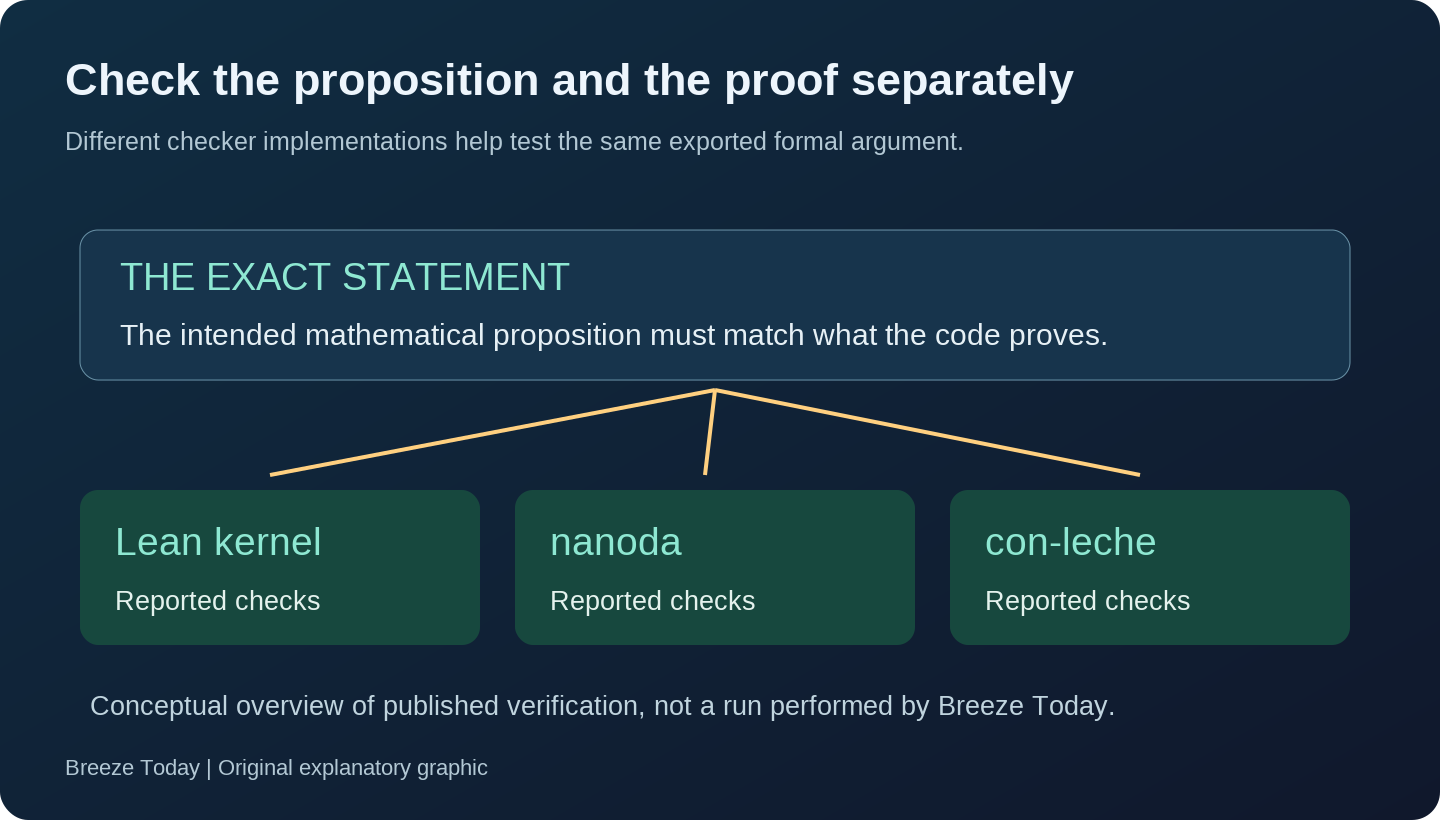
The joint statement describes comparisons between the submitted theorem and the established RiemannHypothesis definition in Mathlib. It also cites checks by independently implemented proof checkers. The intended role of these steps is to establish that the formal result matches the familiar mathematical assertion and that acceptance does not depend solely on one implementation of a checker. That is a stronger evidential position than the author simply announcing success.
Andrew Sutherland's MIT page provides a more granular record of individual builds, exports, statement comparisons and checker runs. Its November 22 update reports accepted independent checks while distinguishing other jobs that were still running. It also describes work using inert exported proof data, which separates checking a formal artifact from trusting arbitrary executable behavior in submitted source. This article reports that audit record; it does not claim to have downloaded and rerun the entire massive development.
Read the source Lean / Mathlib communitiesAndrew Sutherland / MITLean prover community
Does the broader result cover every generalized Riemann hypothesis?
No such sweeping conclusion should be inferred from a broad label. The MIT verification record identifies the generalized scope as Dirichlet L-functions, over the moduli and characters specified in the formal statements. It explicitly distinguishes other families, including more general automorphic L-functions. Technical families are not interchangeable simply because public discussions use similar abbreviations for several related conjectures.
This is the same reading discipline needed for the original hypothesis: identify the exact proposition before evaluating the proof. A diagram or headline that drops the qualifier can enlarge the claim beyond the inspected evidence. For a general audience, the essential point is that a verified result can be both extremely important and precisely bounded. Understanding that boundary is part of explaining the achievement accurately, not a reason to dismiss it.
Read the source Andrew Sutherland / MIT
Why do mathematicians still want a readable explanation?
A checked formal argument and a human explanation serve different purposes. The checker asks whether the supplied terms establish the stated proposition within the system. A reader also wants to know which ideas make the proof work, which intermediate results are surprising and how those ideas connect with existing mathematics. A short explanation cannot be manufactured simply by counting lines or extracting the final theorem name.
Original reporting described mathematicians trying to understand the release while verification efforts progressed. The community statement also points toward further explanatory work. A useful account should make the central mechanisms legible and distinguish old ingredients from new ones. The contextual writing and reading footage used in our video illustrates that task; it is not a recording of the author, a specific verification machine, or someone reading the new proof itself.
Read the source Lean / Mathlib communitiesKonstantin Kakaes / Quanta Magazine
Has a million-dollar prize automatically been awarded?
A proof announcement, a verification assessment and a formal prize decision are different events. The Clay Mathematics Institute lists the Riemann Hypothesis among its Millennium Prize Problems and publishes its own award framework. A news report about successful formal checks should not be presented as an award announcement unless an actual decision establishes that additional fact.
The appropriate takeaway from the new development is specific: the claim has received a major public verification endorsement, backed by reported checks of its formal statement and proof. Generating an argument, checking it and explaining it remain distinct achievements. Readers should watch dated primary updates for any material change and look for careful mathematical exposition, rather than treating a striking headline as a substitute for either.
Read the source Clay Mathematics InstituteLean / Mathlib communities
Why a successful build is not the only question
Consider a deliberately simple example. A program can check a correct proof that zero equals zero. That success does not establish a different claim about the prime numbers. A meaningful verification must connect the checked proof to the mathematical statement people intended to ask about. The example is elementary, but the distinction remains important when the codebase is enormous.
This is why the reported theorem-statement comparisons matter alongside compilation. They address whether the theorem established by the library is the vetted statement, rather than a similarly named declaration with a weaker or different meaning. The community statement cited above describes separate checks of the statement, the library and the connection between them.
There is another distinction between building the surrounding project and checking the proof result with the relevant trusted machinery. A report should identify what was independently checked and which assumptions or dependencies remain part of that check. This article reports the published community and independent accounts; it does not claim that our own team has rerun the library or performed a fresh kernel verification.
Read the source Lean / Mathlib communitiesLeanMathlib contributors / David Loeffler
What makes a formal result reproducible and understandable?
A claim about a formal codebase needs a specific object to inspect. The source version, toolchain and dependencies help identify what a reported build or comparison actually concerned. If two people discuss different revisions without saying so, apparently conflicting results can be difficult to interpret. A repository link is a starting point, not a substitute for naming the version behind a check.
Reproducibility and human understanding then do different work. Repeating a check can provide evidence about the formal artifact. A readable mathematical explanation helps people identify the main ideas, assess how the result relates to earlier work and use it in other arguments. Neither task becomes unimportant simply because the other has made progress.
The appropriate follow-up is therefore more precise than asking whether a computer said yes. Which statement was checked, against which definitions, using what source and dependencies? Who reproduced which part? What explanation is available to mathematicians? Those questions keep the significant reported endorsement visible while avoiding an unsupported claim that every institutional, expository or prize-related step is already finished.
Read the source Lean / Mathlib communitiesAndrew Sutherland / MITLean prover communityLean
A little more clarity
Questions, answered
Why check the theorem statement as well as the proof?
A valid proof establishes its actual statement. If that statement differs from the intended mathematical claim, successful checking answers the wrong question. The reported comparisons address this connection to the vetted Mathlib statement. That is why the article separates compilation, the intended theorem and the independent comparison rather than reducing the evidence to one build message.
Lean / Mathlib communitiesMathlib contributors / David Loeffler
Does a formal proof replace the need for a readable explanation?
No. A checked artifact and an explanation serve different purposes. The artifact supports a formal claim about the theorem and its proof; an exposition helps people understand the strategy and apply the ideas. The reporting cited in this article describes continued interest in an accessible account without treating that interest as a withdrawal of the reported formal endorsement.
Andrew Sutherland / MITLeanKonstantin Kakaes / Quanta Magazine
Does the community announcement itself award the Millennium Prize?
No. A statement by the Lean and Mathlib communities and a decision by the Clay Mathematics Institute are different institutional actions. The article reports the former and explains why it should not be presented as an automatic prize award. Claims about an award require an announcement from the awarding institution, not an inference from a verification milestone.
Follow the evidence
Sources and reporting
The original reporting date is shown above. These sources support the reported event and the additional explanatory context; a party’s statement is identified separately from an independent account.
- Joint Lean and Mathlib verification statement, November21Lean / Mathlib communities
- Verification files and dated independent audit resultsAndrew Sutherland / MIT
- Original author announcement, November20Levent Alpoge
- Riemann Hypothesis, Millennium Prize ProblemsClay Mathematics Institute
- About Lean and formal proof checkingLean
- Original reporting on the announcement and verification effortsKonstantin Kakaes / Quanta Magazine
- Community mirror and comparison setupLean prover community
- Original reporting on the AI-assisted proof announcementAssociated Press
- Published formal definition of RiemannHypothesisMathlib contributors / David Loeffler
Images, footage and media credits 8 credits
Mathematical diagrams are original explanations and computed finite examples, not a proof rerun. Stock recordings are clearly labeled historical research context. The 2024 Alpoge photograph is uncropped and native 400x267; the portrait composition is shared under CC BY-SA 2.0 DE and the standalone original retains that license. No pictured stock participant or machine is identified as an actual author or verifier.
- boardYan Krukau. Pexels License. Selected contextual excerpt; muted source audio, crop/resize, captions. Not an actual proof-checking session.
- typingRaddy. Pexels License. Selected contextual excerpt; muted source audio, crop/resize, captions. Not an actual proof-checking session.
- writingIvan S. Pexels License. Selected contextual excerpt; muted source audio, crop/resize, captions. Not an actual proof-checking session.
- workspaceEmanuel Pedro. Pexels License. Selected contextual excerpt; muted source audio, crop/resize, captions. Not an actual proof-checking session.
- bookcottonbro studio. Pexels License. Selected contextual excerpt; muted source audio, crop/resize, captions. Not an actual proof-checking session.
- alpogeMarlene Ruf / Oberwolfach Photo Collection. CC BY-SA2.0 Germany. Whole400x267 image displayed at native size, uncropped/unmodified collection element; image remains licensed under CC BY-SA2.0DE. Public on-screen credit/source/license and article image credits provided. No enlarged low-resolution portrait.
- riemannHistorical Bernhard Riemann portrait, public domain. Public domain,19th-century portrait. Selected contextual excerpt; muted source audio, crop/resize, captions. Not an actual proof-checking session.
- Mathlib definition headerCopyright 2023 David Loeffler / Mathlib contributors. Apache License2.0. Short source-code header shown with original attribution; surrounding English explanation authored by Breeze Today.