
Infinity, one room at a time
How Can a Full Hotel Still Have Room?
A full infinite hotel can accept new guests by changing their room assignments. Follow the plus-one, even-room and odd-room rules, and learn what countable infinity means.
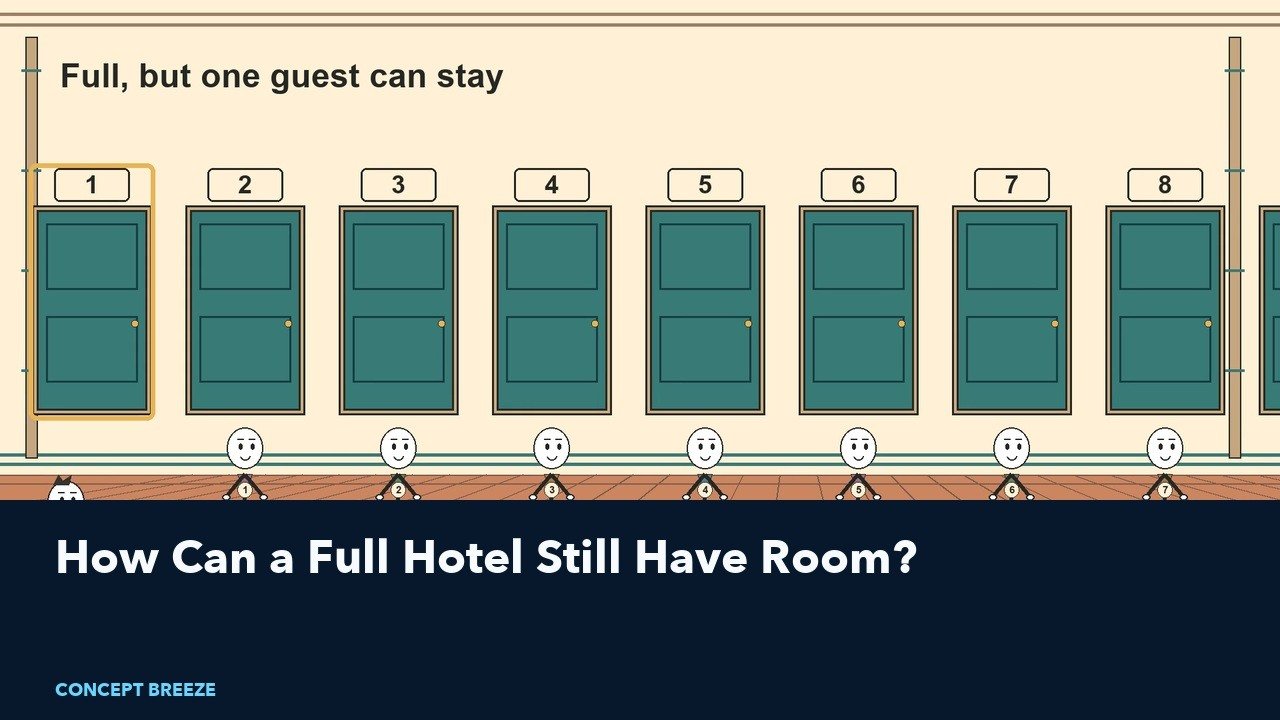
A full hotel, a new arrival and a different kind of capacity
An ordinary hotel with every room occupied cannot accept another guest without changing something. A guest must leave, a room must be shared, or another room must become available. Hilbert's hotel changes a deeper assumption: it has one room for every positive whole number. Its rooms are numbered 1, 2, 3 and onward, with no final room. Every room is occupied, yet the guests can be reassigned so that a newcomer has a room of their own.
This is a mathematical thought experiment about countably infinite sets. It is useful because it separates two questions that usually feel identical: whether every room is occupied under the current assignment, and whether a larger collection of people can be matched to those same rooms under another assignment. The building does not grow. The matching changes.
Read the source American Mathematical Society, Bevin MaultsbyTexas A&M mathematics teaching notesAna Rita Pires / Institute for Advanced Study

Why shifting guests fails in a finite hotel
Consider a hotel with four occupied rooms. Ask the guest in room 1 to move to room 2, the guest in room 2 to move to room 3, and the guest in room 3 to move to room 4. The remaining guest would need room 5. If the hotel ends at room 4, that assignment fails. There is still a guest without a destination.
Making the hotel much larger does not repair that particular rule when the larger hotel is full. Any finite hotel has a last room, and shifting every guest up one room number sends its last guest beyond the available rooms. The infinite model removes the endpoint. It does not hide an unusually large final room somewhere beyond the drawing.
Read the source American Mathematical Society, Bevin MaultsbyTexas A&M mathematics teaching notes
See the distinction
The address rules at a glance
| Situation | Assignment | Available destinations |
|---|---|---|
| One newcomer | Old guest n → room n + 1 | Room 1 |
| Seven newcomers | Old guest n → room n + 7 | Rooms 1 to 7 |
| A new numbered infinite list | Old guest n → room 2n | Odd-numbered rooms |
| Accommodate the new list | New guest k → room 2k − 1 | Each odd room gets one newcomer |
These are complete mathematical assignments. A finite drawing illustrates examples of the rules, not a final room.
Texas A&M mathematics teaching notesRobert Crowston / Cambridge NRICH
One newcomer: assign every old guest the next number
In the infinite hotel, assign the current occupant of room n to room n + 1. The guest from room 1 receives room 2, the guest from room 2 receives room 3, and the rule applies to every positive whole-number room label. Each old guest has a destination because adding 1 to a positive whole number produces another positive whole number.
The assignments do not collide: two different old room numbers cannot become equal merely because the same amount is added to both. No old guest is assigned room 1, since the starting labels begin at 1 rather than 0. The newcomer can therefore take room 1. Every room is occupied again, but the new guest has been included without removing anyone.
Read the source American Mathematical Society, Bevin MaultsbyTexas A&M mathematics teaching notesAna Rita Pires / Institute for Advanced Study
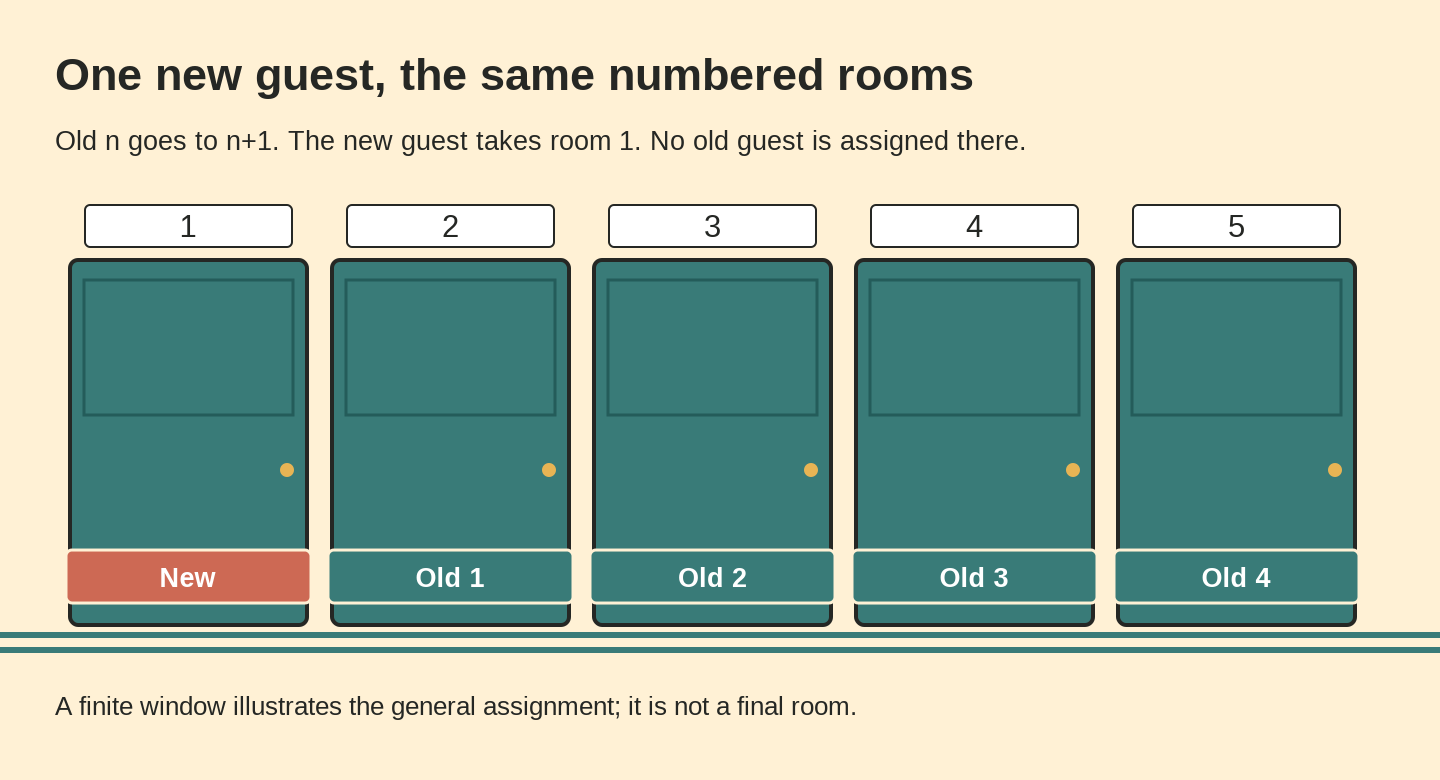
The rule defines an assignment, not an endless moving procedure
The mathematical claim concerns a complete matching between guests and room numbers. It is not a promise that a real manager can walk down an infinite corridor, move every person in sequence and finish the job. The thought experiment leaves physical construction, communication and travel time outside the question it is answering.
That distinction helps avoid a common objection. We do not need to find the last guest and move them first, because there is no last guest. We describe a rule that gives each guest a distinct room. Whether such a rule exists is the mathematical question. Whether infinitely many people could physically carry it out is a different question that this model does not solve.
Read the source American Mathematical Society, Bevin MaultsbyTexas A&M mathematics teaching notesStanford Encyclopedia of Philosophy
Any fixed finite group can be included
Suppose three new guests arrive. Assign every existing guest a room number three larger than their current one. Rooms 1, 2 and 3 are left free, while the old guests move to rooms 4, 5, 6 and onward. The new arrivals can take the first three rooms. The same collision check still works because adding a fixed amount preserves differences between old room labels.
More generally, a fixed finite group of k newcomers can be accommodated by sending old room n to n + k. This opens exactly the first k rooms. The important condition is that k is a particular finite number. Replacing k with an undefined instruction to move infinitely far would not specify a destination room.
Read the source American Mathematical Society, Bevin MaultsbyTexas A&M mathematics teaching notesAna Rita Pires / Institute for Advanced Study
An infinite arrival list needs another rule
Now suppose the newcomers themselves form a numbered list with no last member: new guest 1, new guest 2, new guest 3 and onward. Moving old guests up one room creates only one vacancy. Moving them up a fixed finite number creates only that many vacancies. Neither of those assignments accommodates the entire infinite arrival list.
Instead, send every old guest from room n to room 2n. The original guests occupy the even-numbered rooms: 2, 4, 6, 8 and onward. Every old guest has a destination, and different old labels give different even destinations. All the odd-numbered rooms remain available for the newcomers.
Read the source American Mathematical Society, Bevin MaultsbyTexas A&M mathematics teaching notesAna Rita Pires / Institute for Advanced Study
Odd and even destinations prevent double booking
Match newcomer k to room 2k - 1. New guest 1 receives room 1, new guest 2 receives room 3, and new guest 3 receives room 5. Every newcomer gets an odd-numbered room, and the rule never assigns two newcomers the same destination. This complements the assignment of the original guests to the even-numbered rooms.
The two groups cannot collide because a positive whole number cannot be both even and odd. Together their destinations cover every positive room label. An even room 2n contains old guest n, while an odd room 2k - 1 contains newcomer k. These formulas provide a way to check any named guest or any named room, rather than relying on a picture of a few successful examples.
Read the source American Mathematical Society, Bevin MaultsbyTexas A&M mathematics teaching notesAna Rita Pires / Institute for Advanced Study
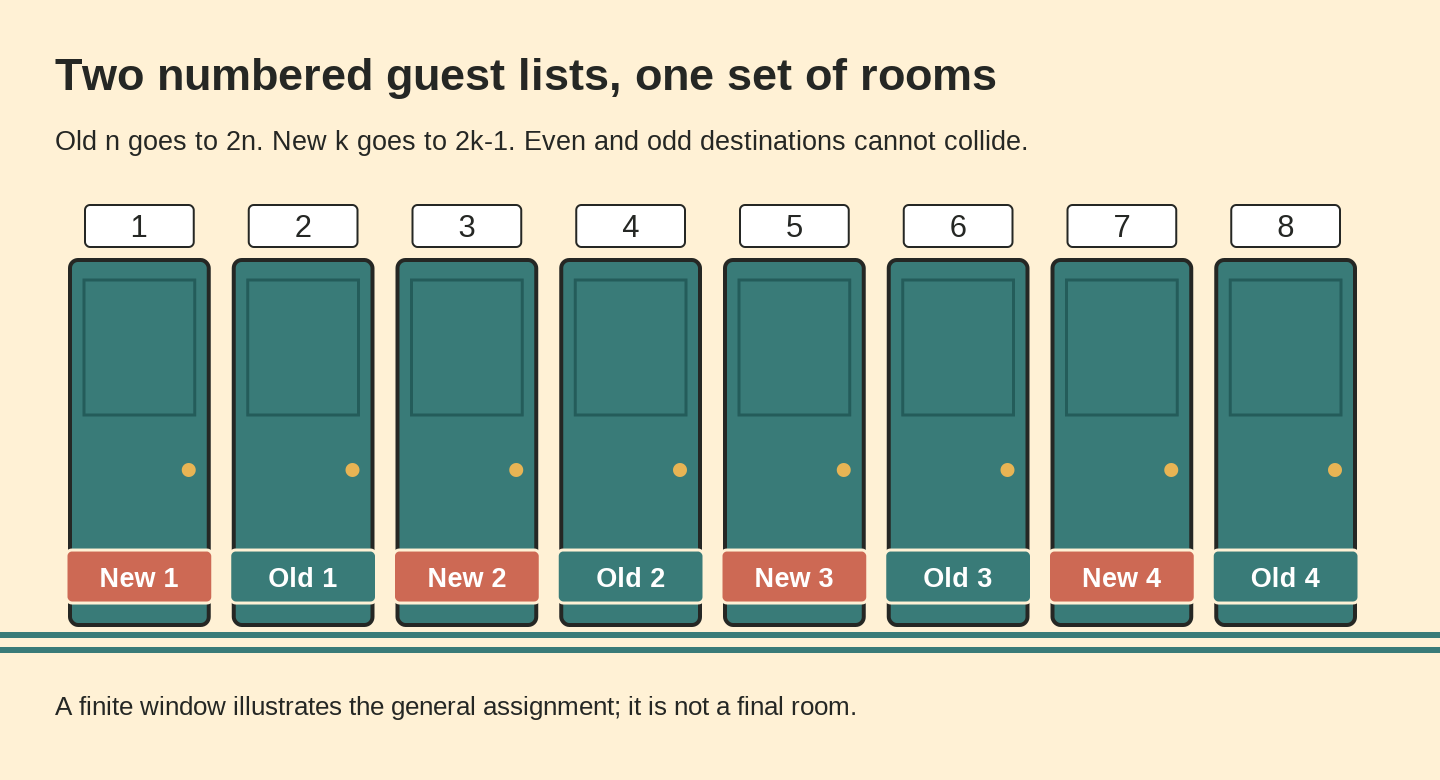
Countable infinity is about one-to-one correspondence
A collection is countably infinite when its members can be paired one for one with the positive whole numbers. The even numbers have this property: pair 1 with 2, 2 with 4, 3 with 6 and so on, using the rule n maps to 2n. The complete list of positive whole numbers and the complete list of positive even numbers therefore have the same cardinality, or set size.
This does not contradict the fact that only five of the first ten positive numbers are even. That statement compares finite initial portions of the lists. Cardinality asks whether the entire collections admit a one-to-one correspondence. Infinite collections can have the same cardinality as a proper part of themselves, which is exactly what ordinary finite-capacity intuition tends to resist.
Read the source American Mathematical Society, Bevin MaultsbyTexas A&M mathematics teaching notesAna Rita Pires / Institute for Advanced Study
What the hotel explains, and where to stop
The hotel gives a clear model for one newcomer, any fixed finite group and a countably infinite arrival list. It does not establish that every infinite collection has the same size. The conditions matter: the rooms and the arrivals in these examples are indexed by positive whole numbers. Each conclusion follows from the particular assignment rule that has been defined and checked.
The portable lesson is to ask for the matching. Does every guest have a destination? Can two guests receive the same room? Which rooms remain unassigned, and how are the newcomers included? Answering those questions turns a surprising story into a precise argument. The full hotel can still have room because its labels have no final member and its guests can be matched to them in a new way.
Read the source American Mathematical Society, Bevin MaultsbyTexas A&M mathematics teaching notesStanford Encyclopedia of Philosophy
Follow a guest far beyond the first few rooms
The first few doors can make the rule look easier than it is. Try a guest far outside the drawing. With the plus-one assignment, the guest in room 1,001 receives room 1,002. A guest in room 500,000 receives room 500,001. Nothing in the formula depends on how far down the list the guest appears. For every positive whole number, adding one gives another positive whole number.
Now reverse the question. If a room has number m greater than one, its old occupant under this assignment came from room m minus one. That identifies exactly one original guest for every room except room one. It is a coverage check as well as a no-collision check: the rule tells us where each original guest goes and which destination remains available.
For seven newcomers, the same idea becomes n plus seven. Old guest 1 goes to 8, old guest 1,001 goes to 1,008, and rooms 1 through 7 have no old guest assigned. The large numbers are not special cases. They help reveal why a rule applying to every positive integer is more useful than a drawing that can display only a few doors.
Read the source Texas A&M mathematics teaching notesAna Rita Pires / Institute for Advanced StudyAmerican Mathematical Society, Bevin Maultsby
Read the two guest lists as an address book
For the second infinite list, give the old and new passengers different address rules. Old guest 20 receives room 40. New guest 20 receives room 39, because twice 20 minus one is 39. Old guest 1,001 receives room 2,002, while new guest 1,001 receives room 2,001. The labels identify both the list and the passenger's position within it.
A room number also tells us how to look up its assigned guest. An even room 2n belongs to old guest n. An odd room 2k minus one belongs to new guest k. Because a positive integer cannot be both even and odd, the two address systems do not overlap. Because every positive integer is one or the other, together they cover the hotel's numbered rooms.
Calling the story a paradox expresses the surprise of applying familiar finite-capacity intuition here. It does not mean the assignment contains a contradiction. The precise task is to define a matching and check it. The fact that the complete positive integers can match their positive even subset concerns infinite cardinality, not the fraction of even numbers in a finite sample.
Read the source Texas A&M mathematics teaching notesRobert Crowston / Cambridge NRICHStanford Encyclopedia of Philosophy
A little more clarity
Questions, answered
Where does the last guest go?
There is no last guest in this model. Each original guest is indexed by a positive whole number and receives another valid number under the rule. In a finite full hotel, the final guest exposes a missing destination. Removing the final room from the model changes that issue; it does not hide the last guest somewhere far away.
Texas A&M mathematics teaching notesAna Rita Pires / Institute for Advanced Study
Does the hotel add new rooms when someone arrives?
No. In the examples here, the set of room numbers remains the positive integers. What changes is the guest-to-room assignment. The plus-one rule makes room one available; the doubling rule assigns original guests to even rooms. The explanation is about matching existing numbered sets, rather than constructing additional physical rooms.
American Mathematical Society, Bevin MaultsbyTexas A&M mathematics teaching notes
Does matching the positive integers to the evens erase the odds?
No. The odd positive integers still exist. A one-to-one correspondence says that every member of one collection can be paired uniquely with every member of the other. It does not say their members are identical or that a finite sample contains the same number from each collection. The distinction between membership and cardinality is the point of the example.
Ana Rita Pires / Institute for Advanced StudyStanford Encyclopedia of Philosophy
Watch a focused explanation
Explore this idea in Shorts
Each Short answers a specific question. Keep reading for the complete context and sources.
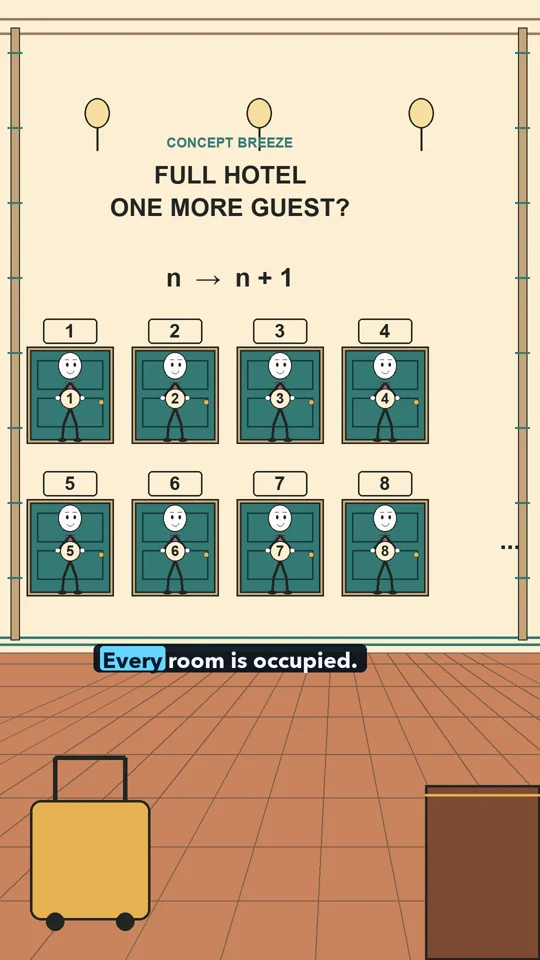
Why Can an Infinite Hotel Fit One More Guest?
Send every existing guest to the next room number and room one becomes available. Check why the rule loses no guest, creates no duplicate assignment and fails in a finite full hotel.
Watch on YouTube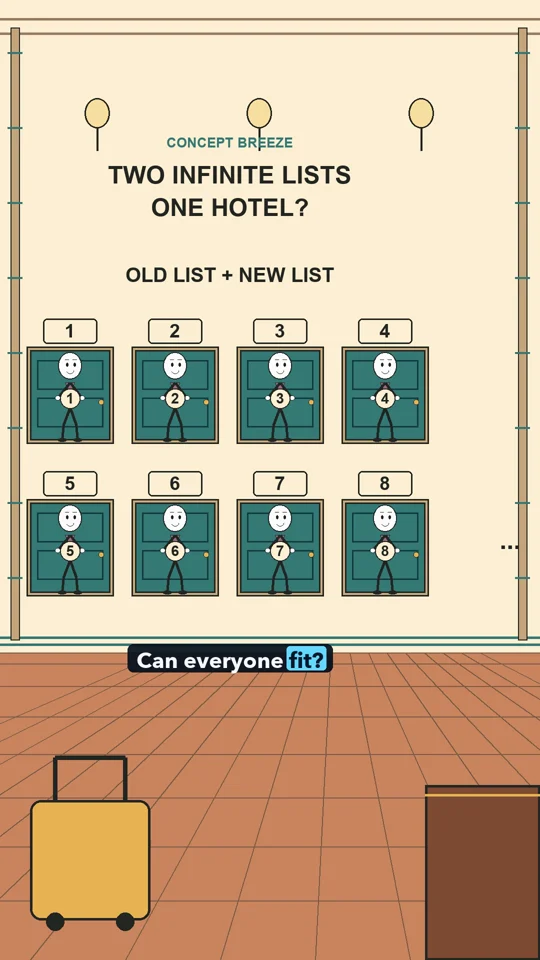
Can Two Infinite Guest Lists Fit One Hotel?
Use even rooms for the original guests and odd rooms for a second numbered list. See how two complete assignments avoid collisions without adding another building.
Watch on YouTubeFollow the reasoning
Sources and further reading
Explore the sources behind the explanation, from the central definitions to the examples and qualifications.
- Primitive Recursion and the Disappearing GuestsAmerican Mathematical Society, Bevin Maultsby
- Hilbert's Paradox of the Grand HotelTexas A&M mathematics teaching notes
- Hospitality at the Hilbert HotelAna Rita Pires / Institute for Advanced Study
- Infinity, section 5.1Stanford Encyclopedia of Philosophy
- Hilbert's HotelRobert Crowston / Cambridge NRICH
Images, footage and media credits 3 credits
Emma, Daniel and the endless hotel are fictional mathematical illustrations. Real lodging recordings show ordinary finite settings only. They do not depict an infinite building or a physical execution of infinitely many moves.
- trolley ordinary lodging contextcottonbro studio. Pexels License. Muted excerpt, native composition/crop, captions and explanation. Filmed 2020-09-16. Not a literal infinite hotel or fictional character identity.
- reception ordinary lodging contextMikhail Nilov. Pexels License. Muted excerpt, native composition/crop, captions and explanation. Filmed 2021-05-07. Not a literal infinite hotel or fictional character identity.
- arrivals ordinary lodging contextKetut Subiyanto. Pexels License. Muted excerpt, native composition/crop, captions and explanation. Filmed 2020-07-16. Not a literal infinite hotel or fictional character identity.